The Scale Illusion
Why Bigger Does Not Mean Better Managed

There is a belief that takes hold somewhere around forty aircraft and becomes doctrine by sixty.
The belief is that operational complexity, at sufficient scale, becomes self-correcting. That a large enough network has enough slack to absorb disruptions. That a team large enough to staff multiple roles can compensate for system gaps through human redundancy. That the problems described in articles about fifteen and twenty-five aircraft carriers are small-carrier problems, and that a sixty-aircraft operation has moved past them.
The belief is wrong. It is just wrong at a higher price point.
The Fleet
A sixty-aircraft mixed operation running forty A320s and twenty A330s under EASA, with a scheduled short-haul network and a long-haul widebody operation, employs approximately 880 crew in total. The calculation applies ratios benchmarked against publicly reported European carrier data: 5.5 pilots and 6.0 cabin crew per A320 for the forty-aircraft narrowbody fleet (220 pilots, 240 cabin crew), and 11 pilots and 10 cabin crew per A330 for the twenty-aircraft widebody fleet (220 pilots, 200 cabin crew). The widebody ratio of 11 pilots per aircraft reflects EASA ORO.FTL augmented crew requirements on sectors above ten hours, mandatory in-flight rest provisions, and the higher recurrent training burden of long-haul type ratings. At the lean LCC end of the short-haul market, published figures run approximately 12 pilots per aircraft for single-type operations; long-haul operators consistently run at the higher end of the 10 to 12 range. The figures used here are consistent with a full-service mixed-fleet carrier operating under standard EASA collective agreement terms.
This is not a small carrier with a small carrier’s problems. The Hidden Ledger at this scale runs EUR 90 to 140 million over five years at conservative estimates. The invoice is larger. So is the organization that has learned not to read it.
The Disruption That Got Absorbed
On a sixty-aircraft operation, most disruptions do not produce visible failures. They produce invisible costs.
An A330 departing four hours late does not strand its passengers. The connections are rebooked. A spare aircraft covers the next sector. The crew are rested and legal by the time the rotation resumes. The operations center handles it. Everyone does their job. The operation continues.
What the operation does not capture: the four-hour delay consumed EUR 24,000 in direct delay cost at EUR 100 per minute. The spare aircraft pulled from the reserve pool means the short-haul A320 operation ran without a reserve for six hours. During those six hours, two A320 disruption events were managed without the normal fallback option, producing two minor delays that were each coded as reactionary. The crew reassignments required to cover the A330 delay consumed three crew controllers for ninety minutes. The allowance calculations for the reassigned crew will not pull through automatically because the reassignments crossed a charter-to-scheduled boundary in the system and the allowance rules differ.
Total cost: EUR 24,000 in direct delay plus EUR 18,400 in secondary effects that will never be attributed to the same event. The total: EUR 42,400 for one A330 delay. Distributed across six budget lines. Invisible as a single event.
On a sixty-aircraft mixed fleet, events of this complexity occur multiple times per week. The management team does not see them as a series. They see them as the background noise of running a large operation.
The Three-Screen Operations Center
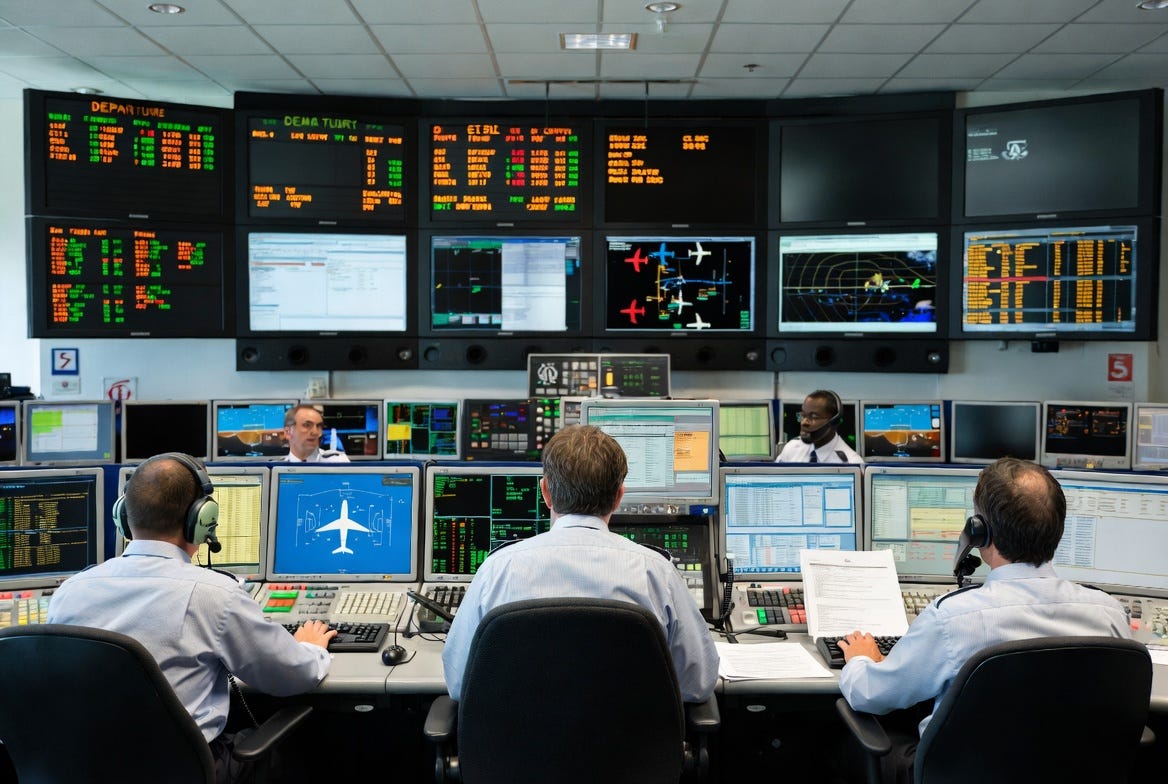
The operations control center at a sixty-aircraft carrier typically runs four to six workstations. Each controller manages a domain: short-haul ops, long-haul ops, crew, technical, ground handling coordination. The domains interact constantly.
What they do not always share is a common operational picture.
The short-haul ops controller knows the A320 schedule. The crew controller knows who is legal and available. The long-haul ops controller knows the A330 rotation status. The ground handling coordinator knows the turnaround status at each base. None of them, in most sixty-aircraft operations, has a single screen that shows all four domains simultaneously with real-time alerts for interactions between them.
When the A330 delay cascades into a crew reassignment that affects tomorrow’s A320 rotation, the short-haul ops controller finds out when the crew controller calls. The crew controller finds out when the long-haul ops controller updates the roster manually. The manual update triggers a notification that arrives in the short-haul ops controller’s queue between the other six items that have arrived in the last twelve minutes.
The gap between event and awareness is not measured. It is not measured because nobody has defined it as a metric. It is not defined as a metric because in a large operation, the gap has always existed and the operation has always continued.
The Hidden Ledger charges for the gap anyway.
The Qualification Matrix Nobody Can See
A sixty-aircraft mixed fleet carrier has a qualification matrix of substantial complexity. Pilots hold type ratings for the A320 family, the A330, or both. Cabin crew hold type qualifications for the A320 and A330 separately, with differences training requirements under EASA ORO.CC.125. Some crew hold mixed-fleet qualification. Many do not. Recurrency requirements differ by type. Simulator allocations compete across both fleets. Instructor designations add another qualification layer.
On any given disruption morning, the crew controller needs to know, in real time, which of the available standby crew are qualified for which aircraft on which contract under which rule set.
On most sixty-aircraft operations, this knowledge is held partly in the crew system, partly in a training records system, partly in a spreadsheet that the crew planner updates monthly, and partly in the crew controller’s memory.
The crew controller’s memory is not a compliance system. It is a cognitive load that increases as the operation grows. At sixty aircraft with 880 crew across two types, two or three operational models, and potentially multiple client rule sets, the controller’s mental qualification filter is applied under time pressure to a pool of people that is simply too large to hold in working memory.
The assignment error that results, a crew member assigned to an aircraft type for which their recurrency has lapsed, does not always surface at assignment. It surfaces at check-in. The departure holds while a replacement is found. The delay is coded as crew-related.
The root cause is a qualification visibility gap that a properly integrated crew management system eliminates by surfacing type eligibility at the point of assignment, not at the boarding gate.
The Delay Code Audit
On a sixty-aircraft operation, the delay reporting infrastructure produces hundreds of coded events per month. The codes matter. They drive performance reports. They drive management decisions about scheduling, ground handling contracts, and crew deployment. They drive conversations with airports and slot coordinators.
They also have a systematic bias.
The controller coding a delay at the end of a disruption sequence codes the most defensible available explanation. Weather codes, ATC codes, and reactionary codes are defensible because they reference external factors. Crew codes and OPS codes attract scrutiny. Over time, a culture develops in which the available external code is preferred when an internal code would be equally accurate.
At sixty aircraft, this bias produces a delay performance report that systematically understates internal operational failures. Management believes OTP is better than it is. Management decisions are made against a performance baseline that is optimistic by two to four percentage points. Scheduling decisions that would be revised if the true OTP were visible are maintained because the reported OTP does not trigger revision thresholds.
A dynamic reporting system with automated delay code correlation surfaces the pattern in the first quarter. The manual coding culture at sixty aircraft, left unaddressed, produces EUR 8 to 12 million in misattributed performance cost over five years.
The Scale Premium on Every Category
The nine Hidden Ledger categories do not scale linearly with fleet size. They scale with complexity. At sixty aircraft running a mixed fleet across multiple operational models and crew qualification environments, the complexity premium is real.
The operational inefficiency category runs EUR 20 to 35 million over five years, because sixty aircraft producing manual reports, manually managed FTL tracking, and ops-to-crew notification lags are sixty aircraft worth of daily friction.
The human error category runs EUR 8 to 14 million, because the qualification matrix that a controller manages mentally across 880 crew is a category of error exposure that does not exist at fifteen aircraft.
The crisis amplification category runs EUR 18 to 28 million, because a sixty-aircraft operation where one A330 delay can cascade into six downstream events is an operation where the gap between integrated visibility and siloed awareness is measured in tens of thousands of euros per event.
Total conservative five-year Hidden Ledger at sixty aircraft: EUR 90 to 140 million.
That is not background noise. That is a strategic choice presented as operational normality.
The AI Question at This Scale
At sixty aircraft, the AI conversation is the most sophisticated. Multi-fleet optimization. Predictive disruption modeling. AI-driven crew recovery across short-haul and long-haul simultaneously. Real-time qualification matching at scale.
The technology is real. The vendors are credible. The implementations that work are at carriers that did the homework first.
The implementations that do not work are at carriers that deployed AI optimization against an ops center where four domains run on four systems, where the qualification matrix lives partly in memory, where the delay codes reflect what was defensible rather than what was accurate, and where the ops-to-crew notification gap is measured in minutes rather than seconds.
An AI optimization model running against fragmented, manually-maintained, strategically-coded operational data is not an intelligent system. It is a confident one. The confidence is the problem. At sixty aircraft, confident wrong recommendations are acted upon at sixty-aircraft scale.
The scale illusion extends to AI. A larger operation does not make AI more forgiving of poor data foundations. It makes it more expensive when the recommendations miss.
The homework is the same at sixty aircraft as it is at fifteen. The invoice for skipping it is just larger.

Daniel Stecher is Vice President Business Development at IBS Software, representing iFlight Core globally. Over 20 years in aviation operations. 131 Operations Control Centers visited across 80+ countries. Founder of Airline Crewing and Operations Enigma, a community of 1,133 members across 261 airlines. Thinkers360 Global Top Influencer. All views his own.
Related reading: The Hidden Ledger / The Invoice Nobody Sends / The Cascade Nobody Saw Coming / Quo Vadis AI? / Five Quotients for the Age of AI / It’s Not the Big Who Eats the Small / The Bull in the China Shop Flies a Desk