

Something remarkable happened this week that the aviation industry seems to have missed entirely.
Sam Altman, the man who built ChatGPT, who helped trigger the AI arms race that has airlines signing multi-year AI contracts at unprecedented speed - quietly admitted he may have been wrong. According to Reuters, he conceded he had overestimated how quickly AI would displace white-collar workers. Not a small footnote. The architect of the disruption narrative is revising the blueprints mid-construction.
And over at Tom’s Guide, Amanda Caswell wrote what may be the most honest headline in tech journalism this year: “Even the people building AI don’t know exactly where it’s going.”
Read that again. The people building it. Don’t know. Where it’s going.
Meanwhile, in the aviation industry: Riyadh Air just announced itself as the world’s “first AI-native airline.” Pegasus has partnered with Overwatch AI as a strategic investor. Lufthansa, Delta, Air France-KLM, Emirates and American Airlines are all racing toward what one headline called “aviation’s biggest operational revolution in modern history.” The crew management system market is projected to hit $2.3 billion by 2030.
Everyone is charging toward a destination. Nobody can agree on what it looks like when you get there.
I want to ask the question the industry keeps not asking: What exactly are we betting on, and who told us the odds?
The Admission Nobody Is Talking About
When Sam Altman adjusts his AI timelines, that’s not a minor correction. It’s a signal that the entire predictive architecture, the one that told CEOs, CIOs, and aviation CTOs that AI would revolutionize operations at a specific pace on a specific timeline, was built on confidence that outpaced the evidence.
The Tom’s Guide article puts it precisely: big tech leaders are “softening their once-certain timelines for AI automation, proving that predicting societal tech shifts is harder than it looks.”
Dario Amodei warned of mass unemployment. Bill Gates predicted the end of nearly every job. Forecasters had timelines, roadmaps, disruption curves.
None of them spent much time in an airline Operations Control Center at 3 AM watching a crew controller manually untangle a disruption cascade affecting eleven aircraft, four crew rest violations, three union-specific override rules, and a hotel that no longer meets the airline’s contractual requirements.
Because if they had, they would understand that the hardest problems in airline operations are not computational. They are contextual. And context, the rich, layered, experience-embedded kind, is precisely what AI currently struggles most to replicate.
The Airlines Are Deploying Before the Map Is Drawn
Here is what is actually happening in 2026:
Pegasus Airlines is embedding AI into crew management via a system that lets pilots and cabin crews retrieve operational information using natural language queries. Impressive interface. But natural language access to procedures is not the same as judgment under pressure.
AI Crew Solutions just partnered with Flightscape to bring “CrewPay intelligence” to airlines - automating pay rule calculations during disruptions. Genuinely useful. Genuinely narrow. A problem of arithmetic, not decision-making.
IBS Software is building toward the Invisible Co-Pilot - an agentic AI model designed to work alongside crew planners, not replace them. That framing matters enormously, and I’ll come back to it.
The industry language, however, keeps drifting toward autonomy. “Independently reassign gates.” “Reorganize crew schedules.” “Autonomous aviation management systems.” The marketing is running significantly ahead of the operational reality.
Over 60% of disruption costs are now crew-related, not aircraft-related. Fast crew-plan recovery is, as one April 2026 blog post correctly put it, no longer a nice-to-have. It’s a strategic necessity. No disagreement there.
But necessity is not the same as readiness. And readiness is not the same as wisdom.
The Governance Question Everyone Is Avoiding
I have been in this conversation long enough to know what gets left out.
Toby Benenson, a senior voice in the Enigma community, wrote something a few months ago that I keep returning to. Talking about AI in crew planning, he said:
“What is the system allowed to surface? What remains the planner’s call? Which exceptions escalate? What gets captured when the planner accepts, rejects, or overrides the recommendation? That layer is what prevents the tool from becoming the decision-maker by habit. Not because anyone meant to hand authority over, but because repeated exception handling has a way of becoming the process.”
Read that last line again. Repeated exception handling has a way of becoming the process.
This is the slow-motion accident nobody is modeling. Not a system failure. Not a hallucination that gets caught. A gradual, unintentional authority transfer, where human judgment atrophies not because the AI is bad, but because the AI is good enough, often enough, that the human stops questioning it.
Morgan Lewis, in their top ten aviation industry considerations for 2026, put it bluntly: traditional aviation liability coverage was designed around bodily injury and pilot error. AI-driven systems complicate those assumptions profoundly. The boundary between a cyber event, a product failure, and an operational error “is likely to become a focal point in future coverage disputes.”
Nobody is writing the liability clause for the moment an AI-assigned crew combination produces a fatigue-related incident that a human controller would have caught. Nobody yet has built the governance model to defend an AI-generated roster in union arbitration.
The technology is moving faster than the accountability structures that need to surround it.
The Myth of the AI-Native Airline
Riyadh Air’s announcement deserves scrutiny, not celebration.
“Designed from the ground up without legacy patchwork”, that phrase is doing a lot of heavy lifting. What it means, in practice, is that Riyadh Air starts with no accumulated operational wisdom encoded in its systems. No edge cases from twenty years of disruptions. No institutional memory of what the workarounds are and why they exist.
Legacy systems are genuinely a problem. I have spent years documenting the cognitive debt that accumulates when controllers navigate fragmented, non-integrated tools, the 70% of cognitive energy that goes into system navigation rather than decision-making.
But legacy is also where knowledge lives. A QantasLink crew controller who commented in the Enigma community said it perfectly: the complexity is not in the systems. It’s in the external constraints, the port that doesn’t have specific equipment, the hotel that no longer meets union requirements, the aircraft type restriction added today that isn’t in any manual yet.
An AI-native airline starting from scratch has none of that embedded knowledge. It has clean architecture and empty context. That is a very particular kind of risk that nobody is putting in the press release.
The Pew Finding Nobody Wants to Quote
Here is the number that should be on every AI vendor slide deck in aviation, but never is:
According to Pew Research, just 10% of the population say they are more excited than concerned about AI.
Ten percent.
We are building autonomous crew management systems, AI-native airlines, and agentic disruption recovery layers for an industry whose workers, the controllers, the planners, the dispatchers, the crew trackers - are almost certainly in the 90% who feel more concerned than excited.
This is not a sentiment to be managed with better change management decks. It is a signal about what happens to the human judgment layer when the humans operating the technology have already decided, at a deep level, that they don’t trust it.
My colleague Thierry Pfeiffer, responding to a webinar about AI in IROPs recovery, put the technical concern exactly: “The 15 to 30 minute window claim is presented as the key justification for autonomous decision-making, but it’s also the most dangerous part. Compressing human judgment into that window means errors propagate just as fast as good decisions.”
What happens when agents conflict when the crew AI and the passenger AI reach contradictory conclusions about the same flight? The webinar didn’t answer that. Most vendor pitches don’t either.
The Most Expensive Workaround in the Industry
Picture this. You open your laptop. You launch Claude.ai. You ask it to analyze a spreadsheet, build a presentation, summarize a report. If you are running Windows 11 and Office 365, it works. Seamlessly. The AI reads your Excel file, updates your PowerPoint deck, pulls data across applications. The integration is native. The friction is almost zero.
Now imagine trying to connect Claude.ai to Excel 1.0 running on Windows 3.0.
It would not work. Obviously. Nobody would expect it to work. And any IT manager who proposed spending six figures on custom middleware to force that connection rather than simply upgrading to a modern operating system would be laughed out of the room.
Except that is precisely what airlines are doing. Every single day.
Not with Windows 3.0 literally. But the functional equivalent is running inside crew management departments at airlines right now. Scheduling systems built on 1990s architecture. Operational databases that predate the concept of an API. Crew tracking tools that were designed when the internet was still optional. None of them were built to talk to a large language model. None of them were built to talk to anything, frankly, outside their own closed environment.
And rather than upgrading to the modern foundation that would make AI integration straightforward, airlines are commissioning expensive custom integration projects to bolt 2026 intelligence onto 1998 infrastructure. The middleware consultants are doing very well. The operations are not improving as fast as anyone hoped.
Every reader outside aviation is asking the obvious question right now: why not just upgrade?
That is exactly the right question. And the fact that airlines have been avoiding a clean answer to it for fifteen years is the real story underneath every AI transformation announcement you will read in 2026.
The Bill That Nobody Modeled
CEOs are quietly realizing the AI replacement plan has a problem. Two problems, actually.
One: the token costs for running AI agents at operational scale are now exceeding what they were paying the employees they replaced. The math that looked clean in the boardroom presentation does not look clean in the monthly cloud invoice. Every query, every decision, every recovery recommendation costs tokens. And tokens add up at a scale that no workforce reduction model factored in.
Two: when the tokens run out, the AI stops. Just stops. No continuity. No workaround. No one calling in a favor with another department. Just a spinning wheel where your workforce used to be.
You fired humans to save money and bought a subscription that bills you into a corner.
The employees you let go knew what to do when things broke. They had phone numbers. They had judgment. They had fifteen years of knowing which rule you could bend at 3 AM and which one you absolutely could not. The AI just invoices you for the outage.
And then there is the permission problem nobody wants to talk about.
To do its job, the AI agent needs access. Full access. Your crew data, your operational systems, your contracts, your union agreements, your future network plans. Everything you spent years building, handed over to a process running on infrastructure you do not own, governed by terms of service you did not negotiate, operated by a company whose priorities are not yours.
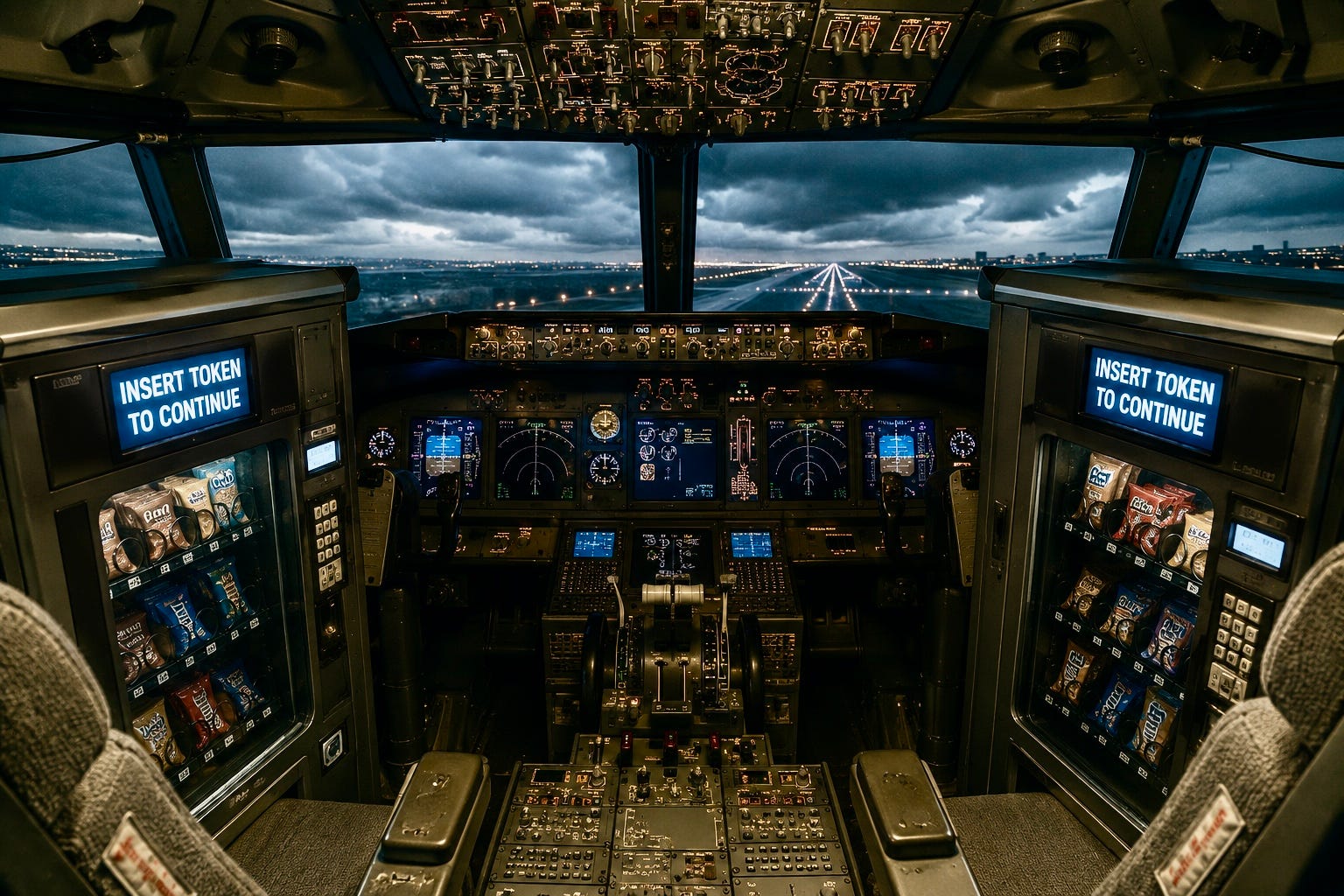
You did not hire a replacement. You gave a stranger with no loyalty, no discretion, and no skin in the game the keys to everything you own.
In any other risk-sensitive context, that sentence would stop a procurement process cold. In the current AI gold rush, it gets buried in the appendix of the vendor agreement.
The GPS Analogy Nobody Wants to Hear
Here is the analogy that creates friction in every room I say it in.
When GPS navigation became mainstream in the early 2000s, the transportation industry celebrated it as a revolution. And it was. Drivers stopped getting lost. Delivery routes became more efficient. The cognitive burden of reading paper maps disappeared.
But something else happened too, quietly and without anyone designing it. A generation of drivers stopped building mental maps. The spatial reasoning that comes from navigating by landmark, by intuition, by memory, began to atrophy. Studies found that GPS users showed measurable reductions in hippocampal activity - the part of the brain responsible for spatial memory and navigation.
Nobody chose that tradeoff. Nobody signed a waiver. It happened through repeated use, one turn-by-turn instruction at a time.
Now ask yourself: what is the equivalent in airline operations?
The crew controller who spent fifteen years building mental models of crew networks, rest rules, airport curfews, and union exception patterns - what happens to that person after three years of accepting AI recommendations 94% of the time? Not because the AI is wrong. Because the AI is right, often enough, that the override reflex softens. The pattern recognition that took a decade to build does not disappear overnight. It quietly, gradually, stops being exercised.
GPS did not make drivers worse navigators by being bad at navigation. It made drivers worse navigators by being good at it.
That is the analogy the vendors are not putting in their pitch decks. And it is the one that keeps me up at 3 AM.
What the Industry Actually Needs
I am not arguing against AI in airline operations. I have written at length about why the Invisible Co-Pilot model - augmentation, not replacement - is the right frame. I believe it deeply.
I am arguing against the particular combination of certainty and speed that currently characterizes how aviation is adopting AI.
The Tom’s Guide article notes that even the technology’s builders admit the narrative keeps changing. “Prompt engineering was described as the ‘job of the future.’ Now many AI companies are actively building systems designed to require fewer specialized prompts.” Search was supposedly collapsing. Instead, it entered a transitional phase. AGI timelines shift monthly depending on who’s speaking.
In any other safety-critical industry, that level of foundational uncertainty about where the technology is going would trigger a governance conversation before a deployment conversation.
Aviation, paradoxically, has the most mature safety culture of any industry on earth - and is currently treating AI adoption like a commercial feature race.
The Right Questions, Finally
Before the next AI partnership announcement, before the next conference keynote declaring that autonomous crew management has arrived, I want the industry to publicly answer a handful of questions that have been sitting unanswered in the room for two years:
When the AI makes a wrong call that a human would have caught, who is accountable, the airline, the vendor, or the algorithm?
What is the explicit governance model for when an agent’s recommendation gets overridden? Is that override data being captured, analyzed, and fed back into the system? By whom?
If 60% of disruption costs are crew-related, and AI is now being used for crew recovery decisions, what is the failure mode? What does a cascade error triggered by an AI misclassification look like at scale?
What is the plan for authority gradient drift, the slow transfer of decision ownership from human controllers to AI systems that nobody intended but that repeated use makes inevitable?
And most fundamentally: are we deploying AI because we understand what it will do, or because our competitors are deploying AI and we cannot afford to look like we aren’t?
The second answer is completely understandable. It is also the one that has produced most of aviation’s worst decisions.
Quo Vadis?
The Latin title of this piece means “Where are you going?” It comes from the Gospel of John - Peter fleeing Rome, meeting a vision of Christ, asking: where are you going?
The story ends with Peter turning back. Not because the destination changed, but because he finally understood the stakes.
The AI builders have now admitted they don’t fully know where the technology is going. That is not a reason to stop. It is a reason to walk differently - with governance structures, accountability frameworks, and explicit human authority layers that match the uncertainty.
Aviation, of all industries, knows what happens when you move faster than your safety architecture.
The question is whether we’re asking ourselves the right question before we find out again.
If this provoked a reaction, agreement, fury, or anything in between , the comments are open.

Daniel Stecher is Vice President Business Development at IBS Software, representing iFlight Core globally. Over 20 years in aviation operations. 130 Operations Control Centers visited across 80+ countries. Founder of Airline Crewing and Operations Enigma, a community of 1,130 members across 261 airlines. Thinkers360 Global Top Influencer. All views his own.