The Invoice Nobody Sends
And Why AI Cannot Save You From It

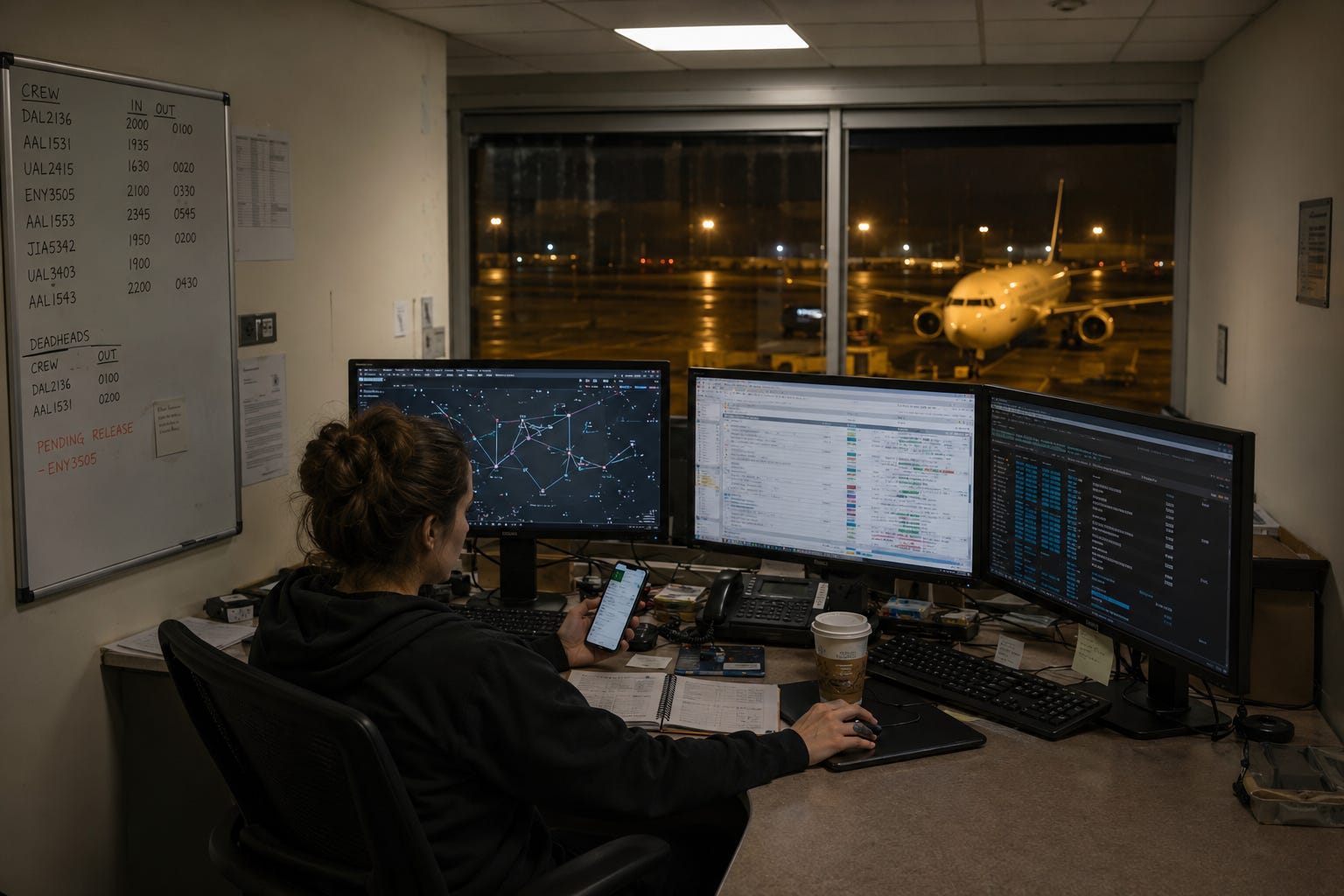
There is a piece of paper that every airline generates every day and nobody ever files.
It does not appear in the annual report. It does not show up in the management accounts. It is not on the operations director’s desk and it is not in the board pack. But it exists, and it accumulates, and the people doing the work know exactly what it feels like even if they have never seen the total.
For a small carrier, that total is not small.
The WhatsApp Delay Report
At a twenty-aircraft European regional, the duty manager handles most things personally. She knows the fleet. She knows the crew. She knows which captain will push back if the turnaround is tight and which ground handler at the outstation picks up on the second ring.
Tonight she will also compile the delay report manually, pull the numbers from three different places, reconcile the discrepancy between what the system shows and what actually happened, and send it to the operations director via WhatsApp because that is faster than the official channel and everyone reads WhatsApp.
By the time it arrives, the most recent event in the report is four hours old. The director will read it in the morning. He will make tomorrow’s decisions on yesterday’s reality.
This is not a failure of the duty manager. She is doing more than her job description says and doing it well. The failure is structural. The information exists. The people who need it exist. The gap between them is filled by a manual process that could be automated, scheduled, and delivered in real time to everyone who needs it simultaneously.
The cost of that gap is not recorded anywhere. It is absorbed into the daily texture of a small operation where everyone is used to being slightly behind the actual state of things. It feels like normal. It is not normal. It is expensive.
The Two-Day Roster
To understand the scale of the crew planning problem at a twenty-aircraft A320 carrier operating under EASA regulations, it helps to know how the crew numbers work.
An A320 in standard 180-seat configuration requires a minimum of four cabin crew under EASA ORO.CC.100, one per fifty passenger seats. Add two flight deck crew and you have six crew per rotation. But six per rotation does not equal six per aircraft. Under EASA ORO.FTL, pilots face mandatory rest requirements, annual flight hour limits, recurrent training, line checks, and CRM cycles. Cabin crew carry equivalent constraints with proportionally higher standby pool requirements.
Published benchmarks from short-haul operations in Europe show lean LCC carriers running at approximately 4.6 pilots per aircraft and 4.7 cabin crew per aircraft. Applying those ratios to a twenty-aircraft LCC A320 operation produces approximately 184 pilots and 376 cabin crew, around 560 crew in total. That is the crew pool one planner is managing.
She builds the monthly roster manually. Not because she does not understand optimization. Because the system she is working in does not do it for her.
She knows the rules. She applies them carefully. She knows which crew member is approaching their annual limit, which base has a surplus of captains next week, which set of pairings creates an illegal rest if the rotation slips by one day under the WOCL encroachment provisions. That knowledge is valuable. It took years to build.
It also takes two days to apply every month. Two days of concentrated focus, interrupted by disruption queries and rule clarification requests and the inevitable question from a crew member who wants to swap a duty. Two days that produce a roster which, by the time it is published, is already slightly out of date because three things changed while she was building it.
A modern optimizer runs the same process in a fraction of that time. The planner’s judgment is still essential. What changes is what she is applying her judgment to. Instead of constructing the roster from first principles, she is reviewing, adjusting, and approving a compliant solution that the system produced while she was doing something else.
The two days do not disappear. They get redirected to work that actually requires a human being.
The Twenty-Minute Search
A crew member has reported sick at an outstation. The departure is in ninety minutes. Someone needs to find a replacement.
At a small carrier, that someone is the duty manager. She opens the standby list. She checks who is legal under EASA FTL. She cross-references the base. She calls the first candidate. No answer. She calls the second. Available but based at the wrong station, and positioning would cost more than the ticket revenue on the service. She calls the third.
Twenty minutes later, she has a replacement. The departure slips by fifteen minutes. The next rotation absorbs it. The crew member who took the duty will have his allowances calculated manually at the end of the period because the short-notice assignment does not flow through the system cleanly.
At one hundred euros per operational disruption minute, the twenty-minute search costs two thousand euros in direct delay exposure. The additional allowance calculation error that surfaces three weeks later costs something else. The duty manager’s cognitive load, the attention pulled away from the three other things happening simultaneously at ten in the morning, does not appear on any ledger at all.
A best-fit crew assignment function does this in under a minute. It checks qualifications, EASA rest requirements, base, positioning cost, and current allocation simultaneously. It does not call anyone. It surfaces the answer.
At a twenty-aircraft carrier, crew disruption events happen multiple times per week. The annual cost of the difference between twenty minutes and one minute is not theoretical. It is just unrecorded.
The End-of-Month Reconciliation
At the end of every roster period, someone is checking the allowances manually. At a small carrier, that someone might be the crew planner, the operations administrator, or a payroll coordinator who has learned the crew rules well enough to spot the gaps.
She is checking which overnight qualifies for which rate. Which crew member flew an additional sector that triggers a supplementary payment. Which in-charge assignment crossed the threshold. Some of it flows through automatically. Some of it does not. The ones that do not require a manual entry. There are enough of them to consume most of a working day every month.
When an error slips through, the crew member raises it. Someone investigates. Someone corrects it. The process works. It just works at roughly four times the cost it needs to.
None of this is the fault of the people doing it. It is the fault of the architecture they are working inside. A system that requires manual allowance reconciliation at a small carrier is not a crew management system. It is a crew tracking system with a payroll problem attached.
What the Ledger Says at This Scale
The standard assumption in aviation is that operational friction is a large-carrier problem. That the economics of legacy architecture only become visible at a hundred aircraft or more. That a twenty-aircraft regional is too small for this to matter.
The assumption is wrong.
At a carrier operating twenty A320 aircraft, around 230 crew under EASA regulations, and around 120 daily sectors across a short-haul European network, the five-year Hidden Ledger looks like this.
Operational inefficiency: manual reporting, manual roster construction, manual exception management. At one hundred euros per operational disruption minute, even conservative avoidable delay across 120 daily sectors compounds quickly. Five-year estimate for this tier: twelve to eighteen million euros.
Human error from fragmentation: ops and crew systems that do not share a single operational picture. The departure that slips because ops did not know the crew consequence of a gate change. The FDP calculation that runs close to the EASA limit because the original delay was coded incorrectly. Five-year estimate: four to seven million euros.
Crisis amplification: disruptions that compound because the tools to contain them are slower than the disruption itself. At a small carrier, one crew member going sick at an outstation can affect four downstream services. There is no slack in the network to absorb a twenty-minute crew search. Five-year estimate: eight to fourteen million euros.
The integration tax, talent attrition, and competitive disadvantage categories scale down but do not disappear. A small carrier that loses its experienced crew planner loses the institutional knowledge that the system does not carry. A carrier paying for middleware connections between systems that were never designed to talk to each other is paying a tax on architecture debt it did not choose.
Total conservative five-year Hidden Ledger for a twenty-aircraft European A320 carrier: thirty to fifty million euros.
That is not a rounding error. That is a fleet renewal. That is five years of route development. That is the difference between an airline that survives a fuel crisis and one that does not.
The AI Question
At some point in this conversation, someone will suggest that artificial intelligence is the answer.
They are not wrong. They are just early.
AI-driven disruption prediction requires clean, consistent, real-time operational data as its input. If the operational picture is assembled manually every four hours and distributed by WhatsApp, there is no data for the model to work with. The prediction is only as good as the feed.
AI-assisted crew optimization requires a complete, structured rule set that the system understands in full. If half the rules live in the planner’s head and the other half are documented in a spreadsheet from 2019, the optimizer cannot enforce them and the AI cannot learn from them. EASA FTL compliance alone involves dozens of interacting constraints: basic daily FDP limits, WOCL encroachment reductions, rest period requirements, cumulative duty limits across 28 consecutive days, annual hour caps. Those rules need to be in the system, completely and correctly, before any AI layer can reason about them.
AI-generated operational recommendations require an integrated view of the operation: where every aircraft is, where every crew member is, what the downstream consequence of a change will be before the change is made. If ops and crew are running on separate systems with a four-hour information lag between them, the AI is recommending against a model of the world that stopped being accurate this morning.
The airlines that are adding AI to manual, fragmented, partially documented operations are not getting artificial intelligence. They are getting artificial confidence. The output looks authoritative. The input is a WhatsApp message sent four hours after the last delay.
This is not an argument against AI in airline operations. It is an argument for sequence. The homework comes first. The integrated data platform, the complete rule digitization, the single operational picture, the automated exception surfacing: these are not boring prerequisites that AI will eventually make unnecessary. They are the foundation without which AI has nothing to stand on.
A twenty-aircraft carrier that builds that foundation is not behind the curve. It is ahead of every carrier that skipped the homework and is now discovering that the AI tool they bought requires inputs that do not exist in their operation.
When AI is genuinely ready to add compounding value at operational scale, the carriers that did the preparation will have something worth pointing it at. The others will be doing a manual reconciliation of why the model’s recommendations did not match what actually happened.
The Visibility Problem
The Hidden Ledger runs positive at every fleet size. It always favors transformation over the status quo. The numbers are smaller at twenty aircraft than at two hundred, but the ratio is not. The cost of inaction relative to the size of the operation is the same.
The invoice exists. It is just distributed across dozens of decisions that nobody was asked to total. The WhatsApp message. The two-day roster. The twenty-minute search. The end-of-month reconciliation. Each one feels like the cost of running a small airline. Together, they are the cost of not running it differently.
The carriers that have understood this are not managing technology projects. They are managing a visibility problem. They have added up the invoice, compared it to the investment required to eliminate it, and made a decision that any rational accountant would make in five minutes.
The total is out there. It is just waiting for someone to add it up.
And no, the AI will not add it up for you. Not yet. Not until you give it something to work with.

Daniel Stecher is Vice President Business Development at IBS Software, representing iFlight Core globally. Over 20 years in aviation operations. 131 Operations Control Centers visited across 80+ countries. Founder of Airline Crewing and Operations Enigma, a community of 1,133 members across 261 airlines. Thinkers360 Global Top Influencer. All views his own.
Related reading: The Hidden Ledger / Quo Vadis AI? / Five Quotients for the Age of AI / It’s Not the Big Who Eats the Small / The Bull in the China Shop Flies a Desk
Always sharp as usual, Daniel. You have pointed out something the aviation industry has felt uneasy about saying out loud: the sequence matters.
After years in cargo, ramp operations, and turnaround planning, I know this shape. The fragmentation is not accidental. It's crucial. The duty manager knows which outstation handler picks up on the second ring and the crew planner who remembers the FTL rules are not just filling in gaps. They are the system.
That's the part the AI conversation usually overlooks.
What you've referred to as the "WhatsApp delay report" has a similar counterpart in operations. At multiple stations I have worked at, the shift report from the ground handling agent was the most accurate operational document produced that day. It was filed and then went to a supervisor's phone and then to the floor. The data existed, but the system did not acknowledge it. No one saw this as a problem until the post-incident review.
The distinction I keep coming back to is between operational integration and operational intelligence. Integration is the homework, creating a single picture, compiling the complete rule set, and surfacing exceptions automatically. Intelligence comes after the homework is done. Mixing them up doesn’t just delay AI deployment; it creates a false sense of confidence that's harder to fix than honest ignorance. An airline that knows its data is fragmented can plan for that. An airline relying on AI with fragmented data mistakenly believes it has full visibility.
The crew planner who builds the roster in two days is not the bottleneck. She's part of the system. If you replace her without integrating her knowledge into the architecture first, you have not really modernized anything. You have only moved the knowledge gap forward by one hiring cycle.
"Artificial confidence, not artificial intelligence" is the best description I have seen of what occurs when the sequence is reversed. The challenge with enterprise AI deployments in various sectors is that the output appears authoritative, but the questions it can't answer are often the ones the operation needs most.
Thirty to fifty million euros over five years won’t impress a board. What will get their attention is the cost when the duty manager leaves, and no one built the system to carry what she knew.
That invoice is coming. It just hasn't been tallied yet.