They Called It Transformation. The 600 Know What It Really Was.
General Motors just fired 600 IT workers and hired AI engineers. They used the word "transformation." The question is whether you will be on the right side of it when the swap arrives at your gate.

General Motors just fired six hundred people. Not because the company was struggling, it had just posted a 40 percent earnings beat and raised its full-year guidance. Not because it was cutting costs, it immediately announced it would hire replacements. It fired them because their skills had become the wrong skills. Ninety percent of GM’s autonomous driving code is now written by AI. The IT department that existed to build and maintain legacy systems is not the IT department that a software-defined vehicle company needs. So GM cleared the floor and called it a skills swap.
Read that again. A profitable, growing company, in the middle of its best financial quarter, decided that the workforce it had assembled over years was the wrong workforce for the world it was entering. And it acted on that conclusion rather than scheduling a working group to explore the implications over the next eighteen months.
Now let me ask you something. When did you last sit in a room where someone told your leadership team something that made them genuinely uncomfortable about their own operation?
The Industry That Perfected the Language of Change Without the Practice of It
Aviation has been talking about digital transformation longer than GM has been pivoting to software-defined vehicles. The conferences have had the same themes for a decade. Resilience. Optimization. The digital future of crew management. The AI-powered OCC. Every year the presentations get more polished. Every year the sponsored dinners overlook something beautiful. And every year a meaningful proportion of the airlines in the room go home and patch their legacy systems one more time.
Here is what the GM story reveals that the transformation vocabulary obscures: the gap between stating interest and taking action is where careers go to wait out the clock. Airlines have entire departments whose institutional purpose is to appear to be transforming without actually doing it. The committees, the feasibility studies, the proof-of-concept that somehow never becomes the production system, the vendor evaluation that produces a report that gets presented and then filed.
The carriers who survive the skills swap will not be the ones who talked about AI the most at industry events. They will be the ones who decided, while the business was still healthy, that maintaining a workforce assembled for a pre-AI era was an opportunity cost they were no longer willing to pay.
The pattern is already visible in your own industry
I have been watching airline operations and crew management for long enough to know that the companies best positioned to handle what is coming are not the ones currently writing the most ambitious transformation strategy documents. They are the ones who, years ago, made the uncomfortable decision to replace what was familiar with what was right and then did the hard organizational work to make it stick.
What a Skills Swap Actually Looks Like in Airline Operations
Let us be precise about what GM did, because precision matters when your own version of this conversation is coming.
GM did not automate its IT department. It did not buy a platform that allowed its existing team to do more with less. It concluded that the skills required to build and maintain legacy enterprise systems were fundamentally different from the skills required to manage AI-generated code, build LLM integrations, and operate software-defined systems at scale. The first set of skills had genuine value, for the era that was ending. The second set of skills does not exist in the same people at the same time. So it made the swap.
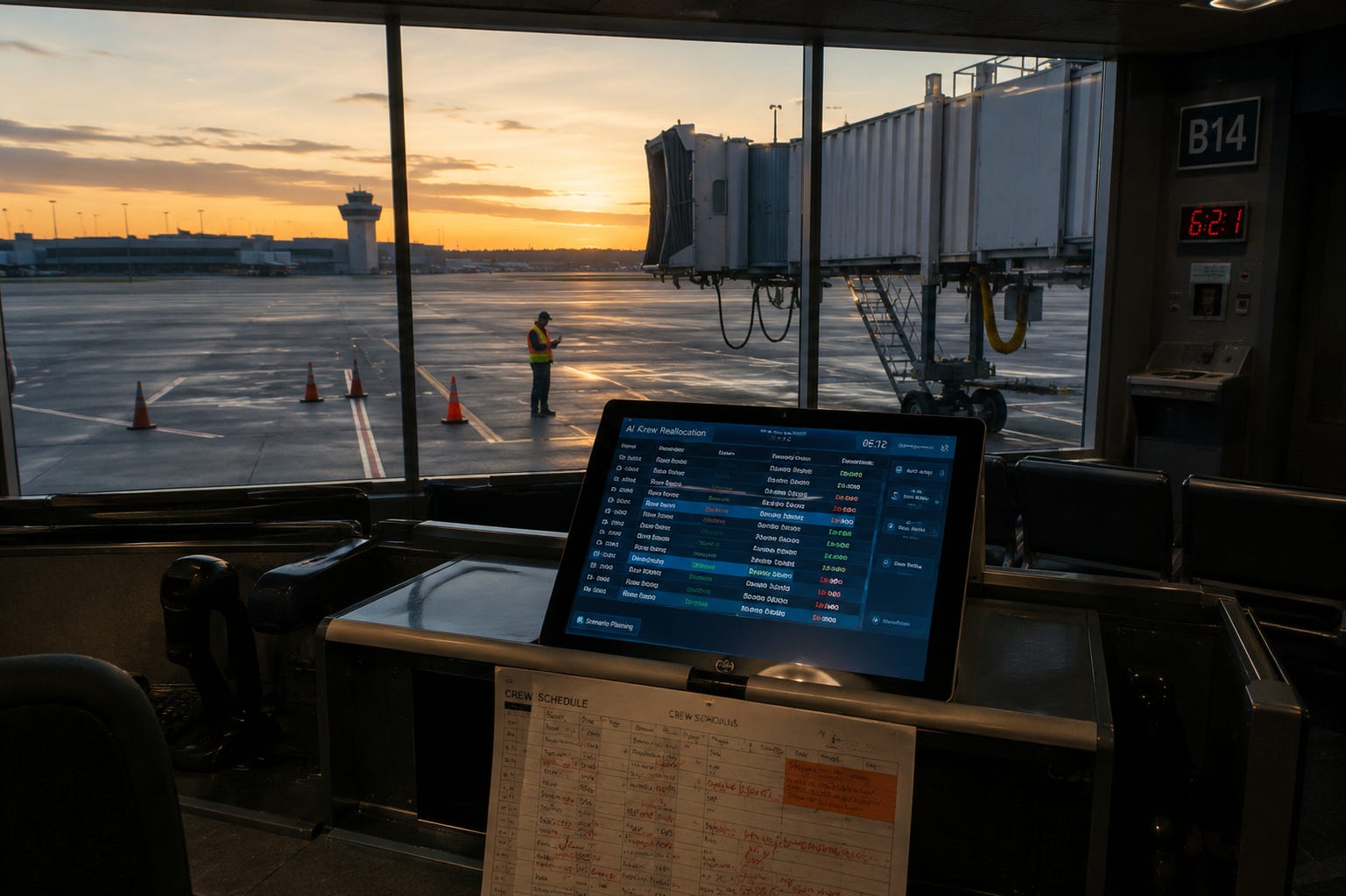
Now map that to airline crew management. For forty years, the operational intelligence in this domain has lived in people. The senior crew controller who knows which captain will accept a pairing on 48 hours’ notice. The planning expert who carries the logic of a collective agreement in their head because the system cannot model it. The dispatcher who has memorized the workarounds for a scheduling tool that was last meaningfully updated when mobile phones had physical keyboards.
The Uncomfortable Parallel
A crew controller at SunExpress read one of my earlier pieces and commented: “Only employees who can truly utilise AI within the next five years will be able to keep their jobs.” She was not writing from fear. She was writing from clarity. She understood what the system she worked in had done to her professional value, reduced her toward button-pushing, and she understood what was coming next.
The operational expertise those people carry is not replaceable by an AI system today. But the 47-click workflows, the manual compensations for system fragmentation, the cognitive overhead of navigating tools that were not designed for human decision-making, that overhead is exactly what AI eliminates. When it does, the question becomes: what is left that only you can do?
The answer, if you have built it, is judgment. Situational awareness. The ability to ask the right question of an AI-powered system and evaluate whether its output makes operational sense. The capacity to escalate the decision the algorithm gets wrong. That is not going away. That is worth more in an AI-assisted environment than it was in a purely manual one.
But you have to have built it. And building it requires working in a system that demands it.
The IT Vendor Reckoning That Is Already Underway
GM’s skills swap has a direct analogue in the vendor landscape, and if you are an IT company selling into airline operations today, this section is the one you should read twice.
The automaker replaced its Qualcomm platform with Nvidia Drive Thor. It integrated Google Gemini. It hired an AI lead from Apple. The decisions were not about capability comparisons at the feature level. They were about which architecture could support the software-defined future the company was building toward. The vendors who built their business on the previous architecture, however successfully, were not invited to that conversation.
Airline operations software has the same inflection point approaching. The vendors who built their market position on workflow automation, compliance calendaring, and regulation-aware scheduling have genuine value. That value is not in question. What is in question is whether those capabilities can become the foundation layer for an AI-native operations platform, or whether they remain a set of tools that AI will eventually route around entirely.
The co-pilot that sits on top of broken architecture is still broken.
Bolting an AI layer onto a system that requires 47 clicks and three workarounds to make a single pairing change does not produce an AI-powered operation. It produces an expensive interface over an unresolved operational problem. Airlines are starting to understand this. The vendors that get there first will have the next decade. The ones that do not will be acquired for their customer lists.
The skills inside vendor teams are subject to the same swap.
The developers who built rule engines and compliance schedulers in the 2000s are not automatically the team best positioned to build AI-native crew management in 2026. This is not a criticism. It is a structural reality that every vendor leadership team should be honest with itself about. GM was honest. It acted while the business was healthy. The vendors that have the same conversation now, rather than after a competitor does, will be in a better position to navigate it.
The airlines watching vendors make this choice are forming opinions that will last a decade.
Every airline COO who has sat through a vendor briefing in the past two years has their own assessment of which companies are genuinely building toward the AI-native future and which are providing roadmaps that look like the future while delivering what was already in the development pipeline. Those assessments are forming right now. They will drive the procurement decisions of the next cycle.
The Question GM Did Not Answer and That Aviation Cannot Afford to Defer
The TNW article on GM ends with an observation that deserves to stand here without editorial comment: the distinction between a cost cut and a skills swap matters to investors and executives. It does not matter to the person who just lost their job because the company decided it needs a different kind of engineer.
That is true. And it points to the only question that matters for every airline that reads this.
Are you building the skills, in your people, in your teams, in your vendor relationships, that will be on the right side of the swap? Or are you maintaining a workforce assembled for a pre-AI era while scheduling a working group to explore the implications?
GM is a profitable company that posted a 40 percent earnings beat, raised its guidance, and then announced it was firing 600 people because their skills were the wrong skills. The strategy may be correct. The workforce question, what happens to the workers whose skills were right until the company decided they were not, is the one no restructuring memo answers.
The Next Web, May 12 2026
The crew controller who told me only AI-capable employees would keep their jobs in five years was not making a prediction about technology. She was making a prediction about institutional courage, about whether the airlines and vendors she worked for would be willing to make the uncomfortable decision while the operation was still healthy, or wait until the decision was made for them.
I have advised more than a hundred airlines through transformations. The ones that acted from strength, not from crisis, not from a regulator’s deadline, not from a competitor’s embarrassment, are the ones that came through with advantage rather than just continuity. The others caught up eventually. Most of them. At considerable cost.
GM did not swap aircraft. It swapped skills. The question for every airline operations leader and every IT vendor serving this industry is not whether that swap is coming for you. It is whether you will design it or endure it.
The 600 in Austin and Warren know which answer they got.

Daniel Stecher is a Senior Aviation Operations Advisor with IBS Software, with more than two decades spent working with airlines across crew management, operations control, and digital transformation. He has visited over 130 Operations Control Centers and advised 350 carriers on regulatory compliance, system architecture, and the organizational change that determines whether technology investments produce outcomes or remain expensive shelfware. He writes about what the industry gets right, what it avoids, and what it will not be able to avoid for much longer.