
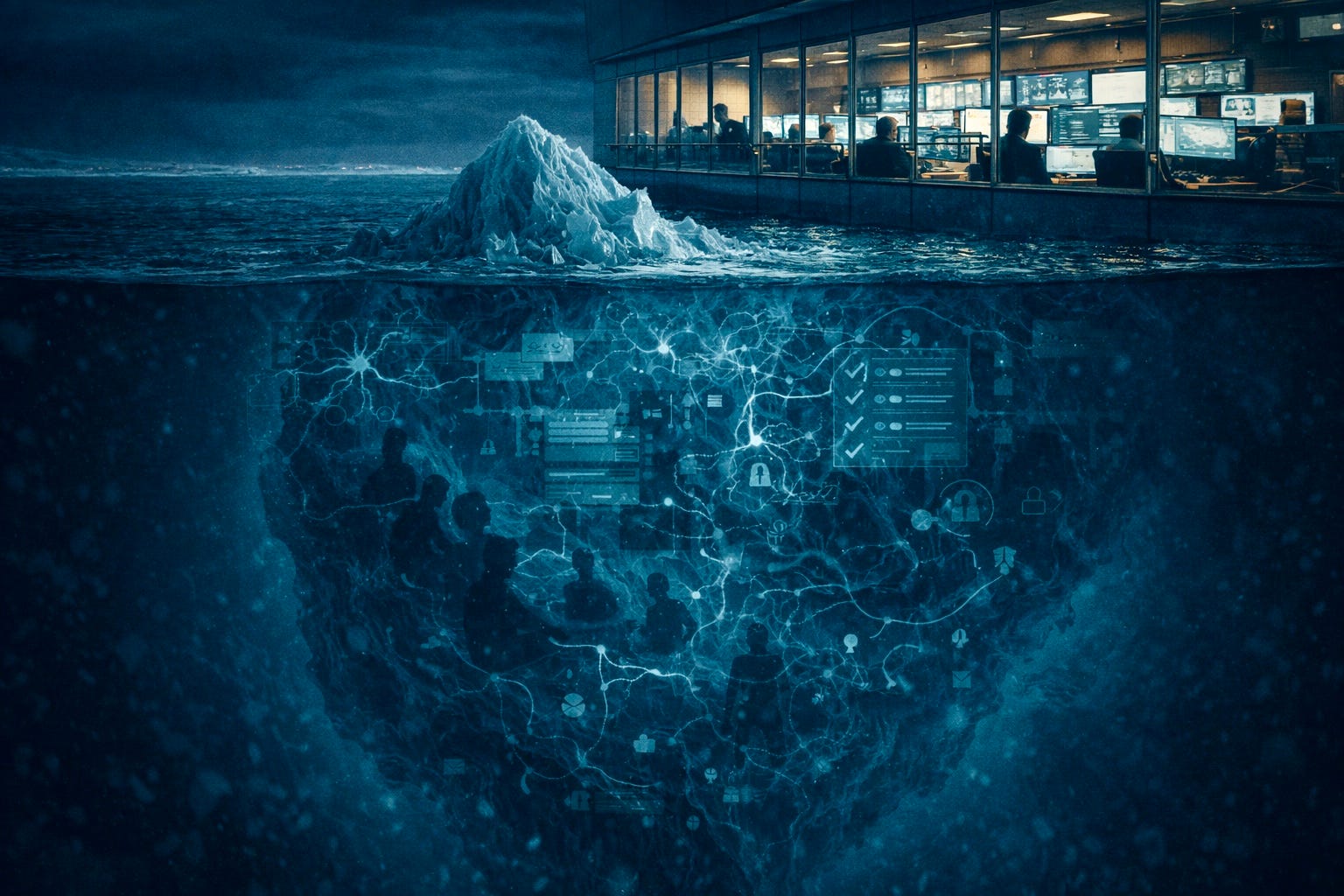
On Tuesday, I hosted an Expert Talk inside the Airline Crewing & Operations Enigma community. 1,112 members. Multiple email reminders. Calendar blocks sent weeks in advance.
Two airline professionals showed up.
I want to sit with that number for a moment, not to shame anyone, because shaming is cheap, but because the reason they didn’t show up is precisely what the talk was about.
They were too cognitively loaded to make space for a conversation about cognitive load.
The irony is not subtle. It’s a system failing to recognise itself.
The Expert
Guadalupe Cortés Obrero is not a theorist who once flew on a plane. She is an air traffic controller with nearly 30 years of operational experience, the founder of the Human Factors department at Spain’s air navigation service provider, and a PhD candidate in organisational happiness management. She sits on a high-level human dimension group advising the European Union.
She is, to use her own framing, both someone who controls traffic and someone who designs the table the traffic is controlled from.
That dual vantage point is rare. And what she said from it should be required reading for every VP of Operations, every Head of Crew Control, every Chief Digital Officer currently signing off on an AI procurement request.
The Myth We Keep Paying For
For decades, the aviation industry has operated on a statistic: 70 to 90% of accidents are caused by human error.
Guadalupe called this the 70% myth, not because the number is fabricated, but because the conclusion people draw from it is catastrophically wrong.
The statistic explains nothing.
In complex socio-technical systems, and an airline Operations Control Centre is precisely that, accidents don’t arise from one component. They emerge from the interaction of multiple components: human, technical, and organizational. You cannot isolate the human from the architecture and call it analysis. You’re just doing accounting.
What actually happens, as Jens Rasmussen articulated decades ago, is this: the same action can lead to very different outcomes depending on context. The cognitive roots of success and failure are identical. It’s the surrounding system that tilts the outcome.
Sully lands the plane on the Hudson River: he’s a hero. Two people die: he’s negligent. Same cognition. Different outcome. Different headline.
The question, Guadalupe said, is not who failed. It is what conditions shaped performance.
That is a question almost no one in airline operations technology is asking. I know, because I’ve attended industry conferences for years and I have never once heard a human factors session on the ground operations side. Not once. And I have presented IT systems to airlines across 80+ countries and have never, not once, had a human factors specialist in the room.
The Architecture Problem
Here’s the business case that doesn’t get made, because business cases are usually about features, not foundations.
When organisations integrate human factors from the start of system design, costs drop dramatically. When they wait, and most wait until problems appear, late-stage changes cost between 60 and 100 times more than early-stage corrections. Approximately 70% of total lifecycle cost is determined before detailed design begins.
That’s not a human factors argument. That’s a CFO argument.
And yet.
The dominant model in aviation IT procurement is this: define requirements, build the system, train people to use it, and then, when the error rates don’t drop, when the cognitive complaints start, when the workarounds multiply, call it a human problem.
It is not a human problem. It is an architecture problem that has been misclassified.
The Slide That Stayed With Me
Guadalupe showed a slide I keep returning to:
“The human being is the most flexible and adaptable component of the aviation system, but also the most vulnerable.”
I interrupted her at that point, because I couldn’t let it pass.
Flexibility and adaptability are not universal human traits. They are personality-dependent. If you have spent any time with Thomas Erikson’s work, his research on DISC-based behavioural profiles, popularised in Surrounded by Idiots, you know that adaptability is not evenly distributed across personality types.
The red profile: action-oriented, decisive, thrives in change. Adaptability is almost effortless.
The yellow profile: enthusiastic, creative, embraces novelty. Flexibility comes naturally.
The green profile: stable, loyal, values consistency. Change is tolerated, but at a cost, and the cost is often invisible until it isn’t.
The blue profile: analytical, precise, process-dependent. Adaptability requires cognitive reframing that is genuinely effortful, not stubborn.
When we say “the human is the most adaptable component of the system,” we are almost certainly designing for one or two of those profiles while unknowingly penalising the others. And the others are not weak links. In safety-critical environments, the blue profile’s precision and the green profile’s consistency are features, not liabilities.
Guadalupe’s response was sharp: selection processes matter, yes, but training matters too, because resilience can be built. Human factors is also how you design and deliver training, not just what the training covers.
She’s right. But I would add: human factors is also knowing who you hired, and designing the system accordingly.
What the Brain Is Actually Doing at 3 AM
Let me give you the cognitive architecture that nobody puts in an RFP.
Rasmussen described three levels of human behavior in operational environments:
Skill-based behavior — automatic, fast, efficient. Highly practiced tasks. Low conscious effort. Vulnerable to slips when routine is disrupted.
Rule-based behavior — procedural, deliberate, checklist-driven. Safe for familiar situations. Breaks down when rules are misapplied or become outdated.
Knowledge-based behavior — novel situation, no applicable rule, active problem-solving required. High cognitive load. Maximum exposure to reasoning errors and overload.
Most crew control systems are designed for rule-based behavior in environments that increasingly demand knowledge-based responses. That gap is not a training failure. It is a design failure.
And then there is Kahneman’s dual-system architecture: System 1, fast and intuitive; System 2, slow and analytical. Experts rely on System 1 because speed is operationally necessary. When a situation becomes genuinely novel, a disruption, an unexpected fleet swap, a chain of cascading crew illegalities, System 2 must engage. That shift takes cognitive resources. And those resources are not unlimited.
The Yerkes-Dodson Law, published in 1908 and still as valid as the day it was written, tells us that performance is optimal at a moderate level of arousal. Too low: underload, complacency, missed signals. Too high: overload, tunnel vision, the loss of situational awareness.
Guadalupe’s description of what overload looks like in a controller was the most precise articulation I’ve heard applied to any operational role:
Loss of information, conscious omissions of actions, altered scanning patterns, slower reactions, degraded prioritization, and, critically, the disappearance of team cooperation as an available option. You forget the mission. You focus on the task.
Read that again in the context of a crew controller managing a hub disruption at 03:00.
That is not a description of someone failing. That is a description of a system extracting more than it was designed to give.
The Recovery Cost Nobody Calculates
One more figure from Guadalupe that I want to make concrete.
When an air traffic controller is interrupted mid-task, someone walks up with a coordination query, a message comes through on a secondary channel, the time required to rebuild full situational awareness is not seconds.
It is up to 20 minutes.
Now think about the average OCC screen layout. The average number of simultaneous communication channels a crew controller monitors. The average frequency of interruptions during a peak disruption period.
Every one of those interruptions is not merely a moment of distraction. It is the start of a 20-minute cognitive reconstruction process, during which the controller is working, but working on an incomplete picture.
We have built entire operational architectures on the assumption that humans snap back instantly. They do not. We snap back eventually, and in the meantime, we compensate, adapt, and absorb the gap into our performance.
Which is why we don’t see the errors. We just see slightly slower decisions. Slightly higher risk tolerance. A team that’s a bit quieter than usual.
And then we wonder why the disruption cost more than the model predicted.
The Actual Business Case
Guadalupe closed with three statements that I want to pass on without modification:
Well-being is an ethical imperative. Well-being is a performance multiplier. Well-being is a sustainability strategy.
She’s not talking about yoga sessions and fruit bowls. She’s talking about the system design itself, an architecture that treats human cognitive capacity as the scarce and precious resource it actually is, rather than the assumed-infinite commodity we currently treat it as.
I’ll add a fourth: in aviation, ignoring human factors is not a cultural choice. It is a cost decision with a deferred invoice. The invoice always arrives.
Why Only Two People Came
I’ve been thinking about this since the session ended.
1,112 members. Two attendees.
My working hypothesis: the people who most needed to hear this talk were too deep in their operational firefighting to carve out 55 minutes. They were operating in knowledge-based mode, depleted, interrupted, cognitively maxed, exactly the conditions Guadalupe described, and a webinar about human factors registered below the threshold of urgency.
Which means the information gap is protected by the very problem it describes.
That’s not a scheduling issue. That’s a structural one.
And structural problems don’t yield to reminders. They yield to redesign.
The next Expert Talk in the Airline Crewing & Operations Enigma community is March 24th. Toby Benenson will be joining to make the argument that you can only automate what you can articulate, which is a conversation the industry is not yet ready to have, which means it’s exactly the conversation we need.
If you found this useful, forward it to the one person in your organisation who keeps asking the right questions and keeps being told there’s no budget for the answer.

Daniel Stecher hosts the Airline Crewing & Operations Enigma community (1,112 members, 250+ airlines) and writes The 3 AM Reading List on cognitive load, operational intelligence, and the human cost of system design in aviation. He represents iFlight Core airline operations and crew management systems globally and has visited 128 Operations Control Centers across 80+ countries.
Daniel, this is so relevant.
The two-attendee figure, in my view, is not a failure of interest — it is a symptom of the very problem the session was designed to address. People are too cognitively saturated to carve out time for a conversation about cognitive saturation. The urgency of the immediate consistently displacing the importance of the structural. That pattern plays out more often than we acknowledge.
Guadalupe’s reframe is so pertinent: the human is rarely the origin of failure; the human is usually where a system-level failure becomes visible. What matters is not who failed — it is what conditions shaped performance.
And yet, the absence of human factors specialists in procurement rooms remains a pattern that is largely invisible — and in my view, the effects are both telling and costly. Late-stage human factors corrections cost considerably more than early-stage integration. That is not an HR argument. It is a capital allocation one.
Which brings me to what resonates most from your piece:
Inside an OCC during a peak disruption, 20 uninterrupted minutes is not a realistic condition — interruptions are not exceptions; they are the environment itself
Most crew control systems are designed for rule-based behaviour, in environments that increasingly demand knowledge-based responses
Novel disruptions — unexpected fleet swaps, cascading crew illegalities, multi-hub failures — require active reasoning, not procedural recall
That gap between system design assumption and operational reality is not a training failure; it is a design failure the industry has been funding indefinitely through deferred consequences
The human cognitive capacity available at 0300, mid-disruption, on a fourth consecutive shift is finite and precious. Treating it as an assumed-infinite commodity is not just an ethical gap — it is an operational liability with a deferred and inevitable invoice.
So, the question worth carrying into every procurement conversation, every RFP, every system design brief is not "what does this system do?" — but "what does this system ask of the humans who will operate it under the worst conditions we can realistically imagine?"
If that question isn't answered before the build begins, the industry will spend considerably more answering it afterward. And the invoice, when it arrives, will not come with an itemized breakdown of where the design decisions were made.