The Room That Predicted Two Collapses
There is a room I think about often.

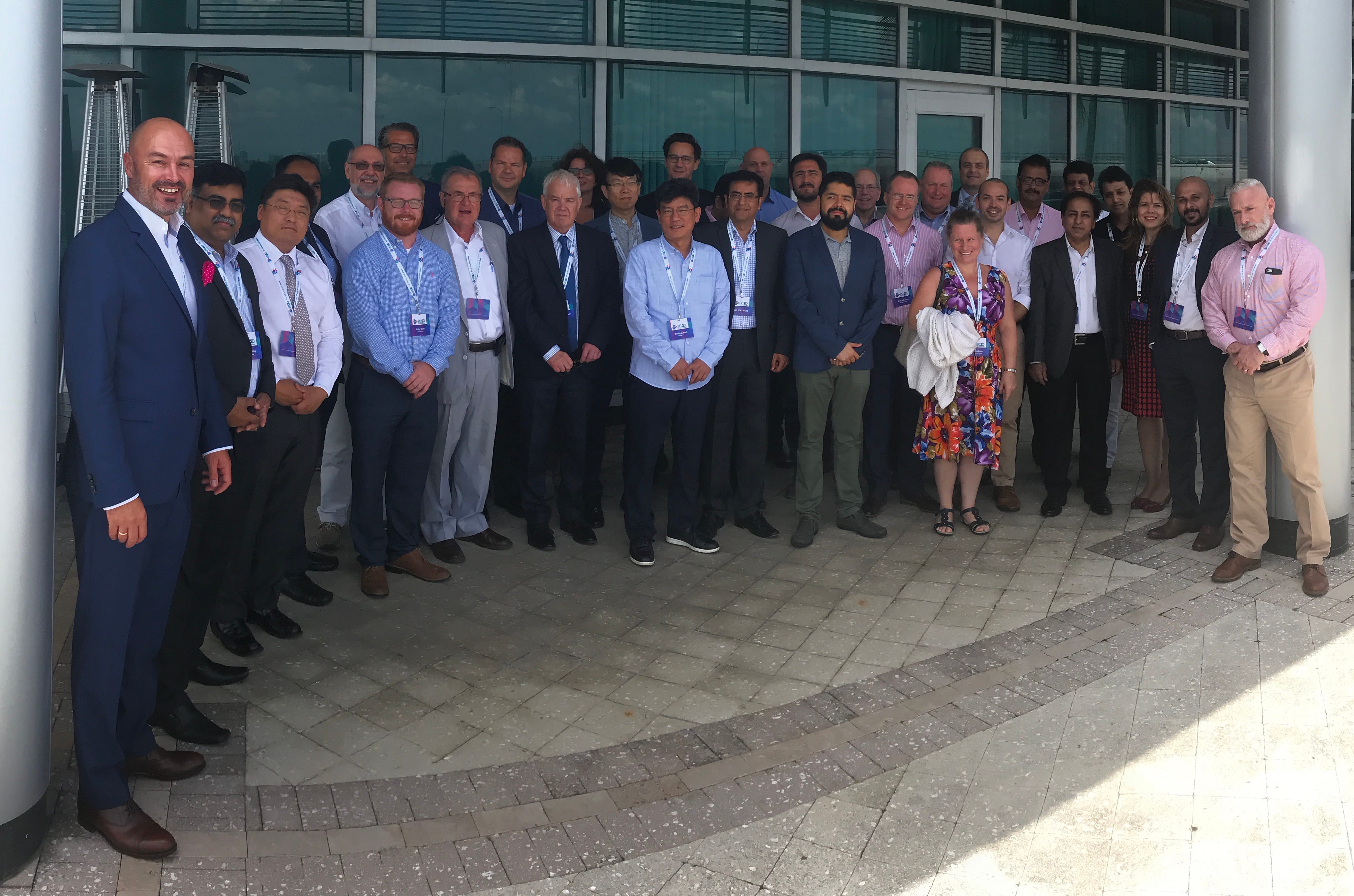
It was at the Ritz Carlton in Bal Harbour, Miami. June 5, 2018. The event was the IBS Software OPS2020 Digital Airline Operations Forum. Registration was free. Two days of working sessions on the future of airline operations technology. The agenda was built around one question: what does the airline operations function need to look like in 2020 and beyond, and what are you willing to change to get there?
Airlines flew in from Seoul, Santiago, Frankfurt, Mumbai, Amsterdam, and Bogotá to answer it.
Jim Tabor opened Day 1. He had spent his career building and running operations control centers, most recently as Vice President of the SOC at Air Canada. His keynote was not a sales presentation. It was a provocation. By 2018, he argued, a passenger with FlightRadar24 on their phone already had better situational awareness of an airline’s operation than many of that airline’s own controllers. The gap between what was available and what was actually running in most OCCs was not a future problem to be addressed in the next planning cycle. It was a present liability, compounding every month the conversation was deferred.
The think tanks that followed drove the point further. Automated decision support. Disruption recovery. Collaborative decision making. Fatigue risk management. Not aspirational topics. Operational gaps that every airline in the room was already paying for in silence, in overtime, in misallocated crew, in disruptions that cost more than they should have, in talent that eventually stopped tolerating the tools and left.
On Day 2, British Airways presented under a title that should have given any legacy operator pause: 1972 to 2018, The Long Journey of a Digital Transformation. British Airways was already running iFlight Crew when they arrived in Miami. They did not come to evaluate. They came because they understood that transformation has no finish line. KLM came for the same reason. Both would subsequently expand from iFlight Crew onto iFlight Ops. The journey continued.
Michael Wuerger, Vice President OCC at Allegiant Air, presented the same afternoon on how Allegiant was managing the operational complexity of their unusual model with a new OCC architecture. He came to share what he knew and learn what he didn’t. Allegiant is still flying in 2026.
Korean Air sent its Deputy CIO from Seoul. LATAM Airlines sent their Crew OCC Manager and two IT colleagues from Santiago. IndiGo sent three people from India. Lufthansa sent teams from both Lufthansa Passage and Lufthansa CityLine. The room contained decision-makers from nine countries across four continents.
Spirit Airlines, headquartered in Dania Beach, Florida, was approximately 30 miles south of the venue. A 35-minute drive on I-95. Spirit sent no one.
· · ·
What happened next is not a mystery. It is a record.
Korean Air selected iFlight and replaced Sabre across both crew and operations. LATAM Airlines replaced their legacy CAE systems with iFlight and the before-and-after operational data from that migration, across aircraft changes, delays, cancellations and crew duty changes, now exists as documented proof of what modern integrated systems measurably deliver.
Lufthansa acted on what the sessions in Miami had crystallized. Their crew management environment had evolved over more than three decades, with components ranging from modern to over 40 years old. IBS retired the Unisys-hosted system entirely. iFlight Crew became the new backbone of crew management across the Lufthansa Group. The 45-year-old platform, a direct analogue of what Spirit Airlines was still running in its Operations Control Center in 2026, was gone.
IndiGo, one of the world’s largest low-cost carriers, became an iFlight customer. British Airways and KLM, already customers when they arrived in Miami, expanded onto iFlight Ops. The airlines that attended kept moving.
The airlines that transformed post-OPS2020 did not do so because change was easy, or capital was free, or their legacy systems had stopped functioning. They did so because they had decided the cost of not knowing was higher than the cost of finding out.
Spirit Airlines continued on its legacy systems. The operational costs of that decision accumulated in silence. They did not appear on any balance sheet. Nobody was asked to defend them. They were paid, quarter after quarter, distributed invisibly across operations budgets and irregular operations costs and HR turnover and IT maintenance contracts that were never questioned because the alternative — admitting the size of the problem — felt more expensive than the problem itself.
This is the mechanism. It is not unique to Spirit. It is structural to an industry that has learned, over decades, to account precisely for the costs it can see and to not look for the costs it cannot. The fuel bill is visible. The overstaffing caused by a crew management system that cannot optimize across constraints is not. The lease payment is visible. The competitive disadvantage accumulated over five years of running systems that better-equipped carriers retired in 2020 is not.
Nobody is ever asked to defend the cost of deferral. They are only ever asked to defend the cost of transformation. This asymmetry is the mechanism by which organisations make the most expensive decision available to them while believing they have made the cautious one.
· · ·
On May 2, 2026, at two in the morning, Spirit Airlines posted a message on its website telling customers not to go to the airport. All flights were cancelled. The airline, founded in 1983, once carrying over 33 million passengers a year, had ceased to exist.
Within 72 hours, 4,853 workers in Florida received WARN notices. The gate agents at Fort Lauderdale. The planners at Orlando. The support staff at Dania Beach, 30 miles from where the question was asked, and not answered, eight years earlier.
Several months before, a European ACMI carrier had suspended operations. Years earlier, their operations and IT leadership had been presented with an integrated platform solution that could have reduced their system count from eleven to one. The presentation was well received. It was never escalated beyond the manager who received it. The evaluation was ongoing when the airline ceased to be.
The executives who chose not to attend, not to evaluate, not to invest, not to decide — they are not the ones filing for unemployment. The people bearing the cost of those choices are the ones who had no part in making them.
· · ·
I have visited 130 Operations Control Centers across more than 80 countries. I have sat in rooms where controllers were doing extraordinary work with inadequate tools, navigating complexity across a dozen disconnected systems, making decisions in seconds that a modern integrated platform would have surfaced automatically. I have watched them develop workarounds for software limitations the way doctors develop workarounds for understaffed wards, with competence and dedication and a quiet exhaustion that never makes it into the annual report.
The knowledge to close these gaps existed in 2018. It was presented in Miami to anyone willing to make the drive. The airlines that made the drive are, in general, still flying. The ones that didn’t are not.
Ignorance has never been free. It simply invoices later, and always to someone else.

Daniel Stecher organized and hosted the IBS Software OPS2020 Digital Airline Operations Forum in Miami in June 2018. He has spent 25 years in international aviation operations technology, working with airlines across the Americas, Europe, Asia-Pacific, and the Middle East. 130 Operations Control Centers visited across 80+ countries. Senior Aviation Operations Advisor, IBS Software. All views his own.