The $34 Billion Number That Changes Everything About the Bloodbath
I predicted a $50 billion bloodbath in US airline SOCs by 2030. A new economic analysis just gave that prediction a sharper edge and a much bigger audience.

In late 2025, I published a deliberately provocative LinkedIn post.
“The $50 Billion Bloodbath: Why Airline Operations Control Centers Will Be Ghost Towns by 2030.”
227,000 impressions. 87 flight dispatchers debated it on jetcareers.com. Hundreds of comments from controllers, schedulers, vendor insiders, and airline executives across four continents.
The dispatchers pushed back with a capability argument. AI cannot match human judgment in complex, high-stakes irregular operations.
They were probably right.
But that was never the relevant question.
The Number I Was Missing
My $50 billion figure was the annual cost of operations control personnel across U.S. airline SOCs, the headcount argument for why AI replacement was economically inevitable regardless of capability.
What I didn’t have was the macro number. The full economy-wide bill for what happens when those SOCs fail to manage disruptions well enough.
A 2022 disruption study cited in recent federal filings puts it at $30 to $34 billion annually. Not just airline costs. The full cascade: lost passenger time, hotel and meeting cancellations, logistics delays, forgone business, reduced demand for future travel. The entire economic ripple from flights that didn’t go when they were supposed to.
Two different measurements. Same problem. Same system.
My $50 billion was what airlines pay to staff the centers managing disruptions.
The $34 billion is what the economy loses when those centers, staffed, resourced, and funded, still can’t prevent them.
Read that again.
We spend $50 billion on operations control, and the economy still absorbs $34 billion in annual losses.
That is not a workforce problem. That is a systems architecture problem that a workforce is being asked to compensate for with their bodies.
What the Dispatchers Got Right, and Wrong
The 87 dispatchers on jetcareers.com who challenged my 2030 prediction were correct that AI cannot replicate experienced operational judgment in high-stakes IROPs. A 44-year US Airways dispatcher who responded to the LinkedIn post made a structural critique I incorporated into subsequent analysis: the complexity of real-time disruption management is not reducible to mathematical optimization, regardless of what any vendor will tell you at Aviation Festival.
But they were arguing about the wrong threat.
The threat was never AI outperforming humans.
The threat was AI outlasting humans in a system designed to exhaust them.
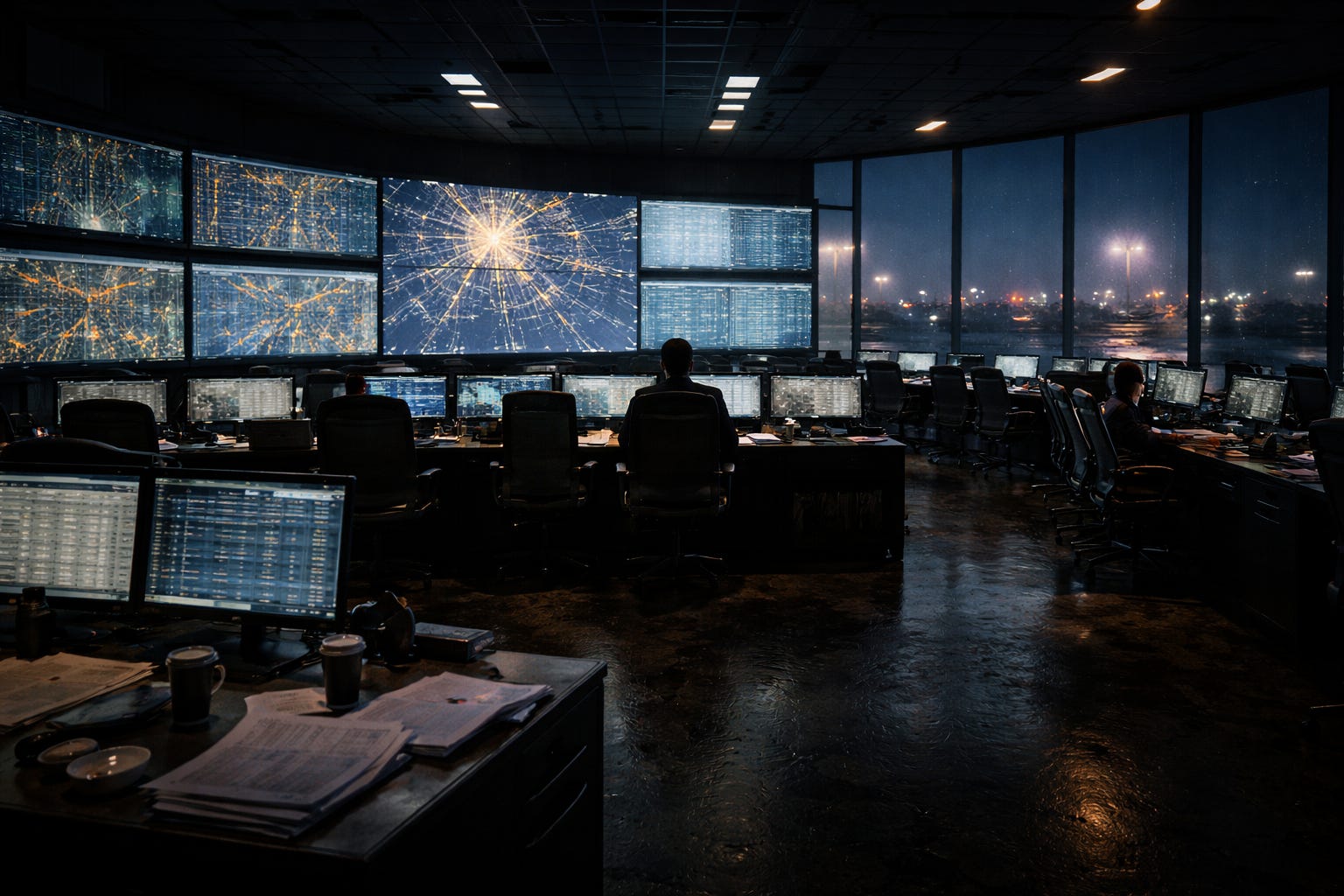
My eye-tracking research across 128 Operations Control Centers showed controllers spending 60 to 70 percent of their cognitive capacity on system navigation. Not on decisions. Not on judgment. Just finding the information that should have been automatic across 11 fragmented platforms with interfaces that haven’t meaningfully evolved since the 1990s.
The $34 billion annual economic loss is that cognitive tax, aggregated at national scale.
Every minute a controller spends reconciling data across systems that don’t talk to each other is a minute the disruption isn’t being managed. Multiply that by tens of thousands of disruptions per year. Multiply by the researchers’ estimate that lost passenger time alone accounts for roughly half the total economic cost. The math resolves to a system that is structurally incapable of performing at the level the economy needs it to perform, regardless of how skilled or experienced the humans inside it are.
The Agentic AI Test Case
Around the same time the $34 billion figure was entering policy conversations in Washington, a webinar was circulating inside the aviation operations community making a different kind of argument.
The claim: Agentic AI was ready to transform IROPs recovery. A unified intelligent decision layer with separate agents handling crew, aircraft, and passengers could replace the fragmented human coordination that makes disruption management so costly. The key justification was the compressed recovery window. Airlines have 15 to 30 minutes to make IROPs decisions. Humans can’t move fast enough. AI must act autonomously.
A senior operations professional on our team watched it carefully and sent back a detailed critique that cut to the core of the Green Horn problem.
His first challenge was about the window itself. The webinar treated time pressure as a justification for autonomy. But a compressed window is precisely when uncaught errors are most expensive. If the system misclassifies a disruption at minute one, wrong rebooking decisions and passenger communications propagate at exactly the same speed as correct ones. Nobody catches it in time. Urgency as a justification for autonomous decision-making is a logical inversion. It is actually the strongest argument for keeping a human in the loop, not removing one.
His second challenge was about agent conflict. The webinar described an orchestration layer where crew agents, aircraft agents, and passenger agents each processed their domain in parallel. But what happens when they reach contradictory conclusions about the same flight? The crew agent recommends holding a departure to preserve crew legality. The passenger agent recommends immediate departure to protect connections for 200 passengers. Both are correct within their domain. Who breaks the tie, and on what basis? The webinar had no answer. No arbitration protocol. No documented fallback. An orchestration layer without conflict resolution is an architecture diagram, not an architecture.
The third gap was regulatory. Not a single mention of EASA, FAA, or airline operations specifications in a webinar presenting an operational blueprint for autonomous decision-making on commercial flights.
The vendor presented at an aviation industry conference shortly after. Our colleague attended specifically to press these questions. The answers were what they usually are when Green Horns are challenged on what they don’t know they don’t know: deferred to future product roadmaps, redirected toward reference customers in early POC phases, and framed as problems the industry would need to solve together.
This is the Agentic AI test case. Not because the framework is wrong in theory. It isn’t. Unified decision layers with intelligent agents will be part of how aviation operations evolve. But the gap between what the system claims to do and what it can actually answer when an experienced operator asks the right questions is exactly the gap I described in the bloodbath post. The confidence without the scars. The Green Horn at the whiteboard with a beautiful slide and no night shifts behind them.
The $34 billion annual economic loss is, in part, the cost of deploying confidence without scars across an entire industry, for decades, at scale.
The Pain Threshold Argument, Revisited
After Greenwashing, AI Washing, and Human Washing, I introduced a fourth concept: Green Horn Washing.
The Green Horn was the newcomer who didn’t yet know what they didn’t know. Full of confidence. Short on context. Every experienced operator recognized them immediately, not because they were incompetent, but because they hadn’t yet failed in the right ways.
AI is the most confident Green Horn in the room.
It doesn’t know what it doesn’t know. It has never worked a night shift through a weather cascade with three violated constraints and no clean answer. It has never felt the weight of a decision the manual doesn’t cover.
And yet.
AI doesn’t experience the fragmented system as pain. It doesn’t burn out navigating 11 platforms. It doesn’t retire taking 40 years of tribal knowledge with it. It doesn’t call in sick during holiday travel chaos. It doesn’t develop stress-induced health conditions from the cognitive load that my research documented in OCC after OCC across 80 countries.
The organizational pain threshold argument works like this: at what point does the cost of sustaining human expertise within a broken system exceed the risk of deploying imperfect AI?
The $34 billion annual economic loss figure is evidence that many organizations have already crossed that threshold without admitting it. The system is absorbing tens of billions in annual damage and continuing to staff it with humans who are being asked to compensate for architectural failures with overtime, experience, and resilience.
When one major airline deploys AI disruption management and survives, even if performance degrades in some dimensions, every other airline faces the same pressure. Not because the AI is better. Because the human alternative has become economically and physiologically unsustainable.
That is still the bloodbath. The timeline may have moved. The mechanism hasn’t.
What the $34 Billion Changes About the Policy Debate
The economic analysis is reshaping conversations in Washington about passenger protections and infrastructure investment. The argument being made to policymakers is that relatively modest public investment in air traffic control modernization could yield large economic returns by trimming average delay times across the system.
This is the right conversation framed around the wrong intervention.
Modernizing ATC infrastructure matters. But the $34 billion is not primarily a capacity problem. It is a decision architecture problem.
The cascading failures happen inside the SOC, not above it. Weather closes a runway. The crew scheduling system, the maintenance system, and the flight operations system don’t communicate in real time. The controller navigating all three simultaneously, on separate platforms, under time pressure, during a night shift, is the integration layer. The human is the API.
When researchers note that lost passenger time accounts for roughly half the total economic cost, they are describing the downstream consequence of decisions made, or delayed, inside operations centers that are structurally underequipped to make them well.
Smarter ATC modernization reduces the frequency of the inputs. Unified operational architecture reduces the cost of the responses. Both matter. Currently, only one of them is in the policy conversation.
Closing the Loop
The $50 billion bloodbath prediction was about headcount economics. The $34 billion macro figure is about systems economics. They are not competing analyses. They are the same diagnosis at different scales.
What I wrote in 2025 about airline SOCs, what a senior operations colleague challenged about Agentic AI’s 15-to-30-minute decision window, what the 44-year dispatcher said about irreducible operational complexity, what the Sabre insider admitted about workarounds being monetized as consulting revenue, all of it resolves to the same structural finding.
We have built a system so fragmented that the humans inside it are spending the majority of their capacity compensating for the architecture rather than managing the operations. The economy is absorbing $34 billion a year as the external consequence of that internal dysfunction.
The bloodbath I predicted in 2030 was always a pain threshold story, not a capability story.
The $34 billion is evidence that the threshold is closer than the dispatchers on jetcareers.com wanted to believe.
And the Green Horns, human and artificial, are already in the room.

Daniel Stecher is Vice President Business Development at IBS Software, representing iFlight Core globally. Over 20 years in aviation operations. 128 Operations Control Centers visited across 80+ countries. Founder of Airline Crewing and Operations Enigma, a community of 1,115+ members across 260 airlines. Thinkers360 Global Top Influencer. All views his own.
In the AI development, "conflict" is a very big topic, as to recognize and overcome "autogressive commitment", starting off "on the wrong foot". Where we (they mostly) compare to human behavior by the way.
Experience is very important, but you mentioned a valid approach: crew agents. But I also learned crew agents being just that. Agents tasked with something. So technically, crew agents are the 10-year-old summa-cum-laude graduates discussing. What "agents" _can_ focus on is to verify the relation of the solution proposed to "ragged" experience. And "warn" the answering AI if it starts on low probability. But (and that was my objection) we talk about crisis decision making. The 2am crisis, when suddenly all the rules went bye-bye.
Still - given the data and information _is_ there (the other bottleneck), and what information _is_ available about the crisis, AI could evolve from the junior ops to an ops manager. Not (at least not yet) on decision making level, but i.e. computing the three best options and presenting them, such saving valuable time.
Then the changed thinking becomes interesting that I work on. If a "learning AI" orchestrates the team, the results can be weighted like a human mind would. Still... Even on a GPU-powered cluster, this takes time. They did a "traffic scenario" (accident, traffic jam) at the executive ops (emergency central), still needed several minutes to analyze, compile, discuss, also while the crisis didn't stop, sit back and wait, but evolved ... then at a point voicing three suggested action paths. And in about 20% of the cases overruled by human experience, "decomplicating" the suggested ideas. But, coming to better results having the three "suggestions". And. 80% the AI "team" was right. And in how many cases would the human emergency operators have been wrong, selecting a suboptimal angle of attack?
So "crew"-based "teams" are improving the results. But they need the ability to learn, not being "experts", but evolving from (10-year-old) junior ops to "16-year-old" valuable ops team member? And maybe further?
The other: We talk about 20 disconnected systems. A solution can be to create agents or teams for each of those systems, then merge them into an "ops team". But that is not just an infrastructure issue (you need a lot of GPU power for such idea), but also a complexity-issue of it's own. As yes, you have conflicts between the different teams. Not just one "agent" against the other, as for each system, you need a team to create and resolve the internal conflicts. Then a smart (enhanced) "manager team" that compiles the information, questions, weighs. Again, even with a lot of GPU, it ain't instant. But in a crisis, I also learned that while some shots come "automatic", especially when the sh** hits the fan, to step back "a minute", assess and discuss is good practice?
So my advise: No disqualification, but a shifting understanding AI not as an omniscient panacea, but a highly competent and learning "expert" (of multiple AI). AI multiplies. Good if good information is the base, bad if it's garbage...
My guess: To create the "ops team member", we would need someone to invest several hundred thousand into a GPU-power-rack. Not on Amazon AWS or OpenAI. Have 3-10 AI teamed up "per system" (modern system you need some 8-24GB VRAM per agent). 20 systems, start with one area. Then define the roles, the conflict resolution, etc. Prototype. At a point you will recognize you don't need a COTS-LLM (commercial off-the-shelf), but need to invest in a custom one ("occ-ai"?). We quickly talk about an investment of beyond a million (it get's cheaper slowly).
Intuitively "too expensive". For "just another ops staff". But I guess taking step 1 is a viable investment. Step 2 will justify if step 1 proves the concept. And I've seen more expensive software or technology investments in aviation. We have the power. But we must open our minds and understand the goal. No panacea. But a fast, competent member for any ops team.
And no, it won't replace human in the loop, but it may reduce the team size by taking out the friction and the repetitive adjustments from disconnected systems. Used right, it will improve the team. Not a tool. But a team member.
But the main question: "Where do you want to go today?" Yes, Bill Gates, 1995. This is pioneering times. But we misunderstand AI capabilities as much as its role. So we run, but without a clear and sound direction. A lot of "activism" on "hype", not on "what is it, what can it become".
I had a Windows tablet, touchscreen, reflective display (full sunlight readable). Tablets are standard today, reflective display isn't. What's an AI?