Pattern Recognition and Pattern Application: The Two Skills That Separate Signal from Noise
A field report from 125 airline Operations Control Centers, 600 RFPs, 350 airlines, and 30 years of watching humans navigate complexity

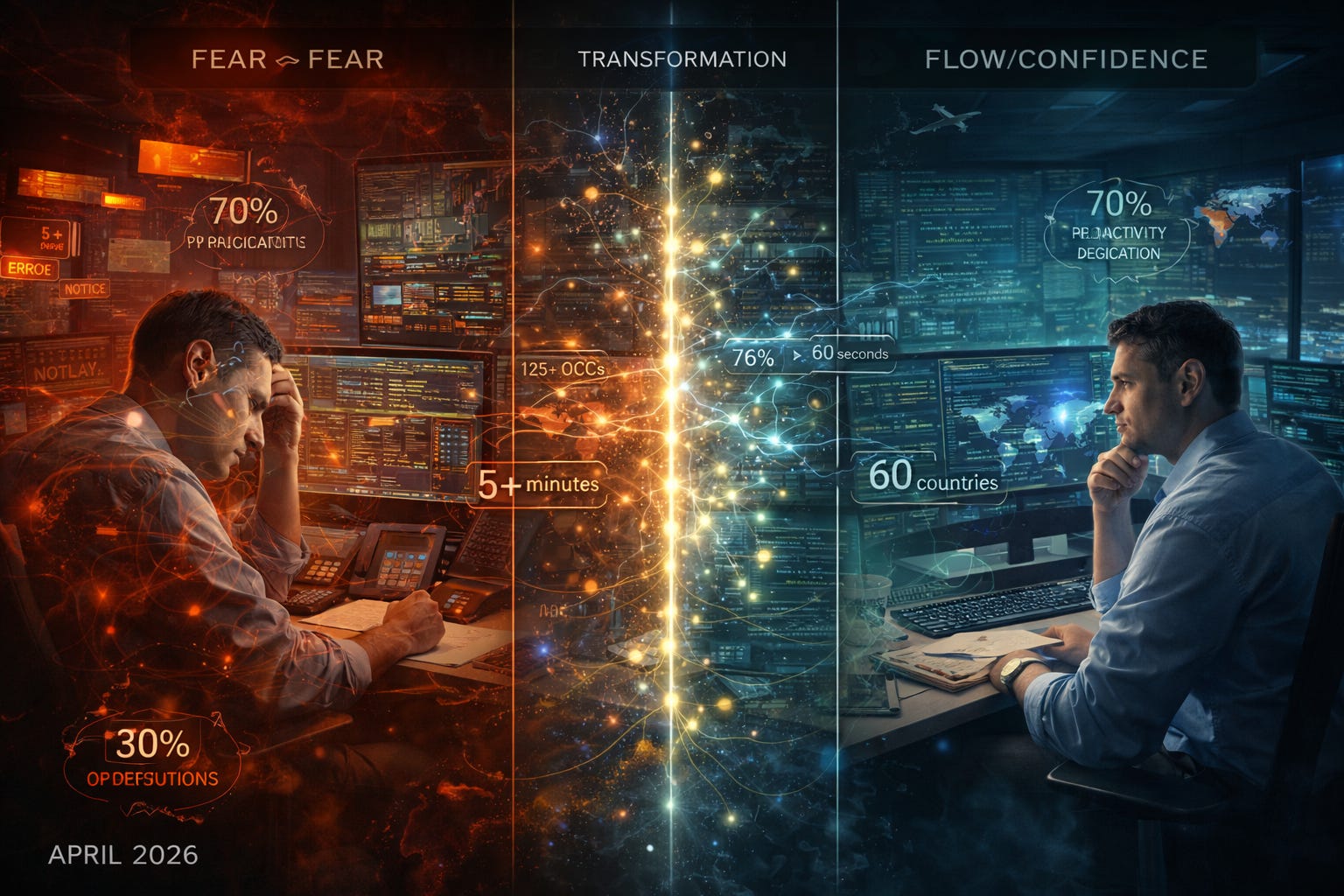
The Keynote Nobody Expected
Last year in Reykjavik, I walked on stage at Grounded 2025 with a simple opening:
“This is not a theory talk. It’s the view from inside 125+ OCCs, across 350+ airlines, and 600+ RFPs. I’ve seen the good, the bad, and the painfully outdated. Today I’ll share a few truths about airline operations that rarely make it on stage.”
What I didn’t tell them: those truths came from 30 years of pattern recognition that started long before I ever set foot in an Operations Control Center.
And they all revolve around one fundamental human challenge: we fear what we don’t recognize.
How I Learned To See What Others Miss
It started in 1994 with cycle messengers in Berlin.
I was hiring bike couriers, conducting thousands of interviews over seven years. At first, I made the same mistakes everyone makes: I listened to what people said about themselves. I got it wrong constantly.
Then something shifted. I stopped listening to words and started watching patterns. How long did someone maintain eye contact? Did they arrive exactly on time, or 3 minutes early? Did they ask about the work or about the pay first? How did they react when I deliberately paused mid-conversation?
The patterns predicted performance better than interviews ever could.
But here’s what I really learned: every interview added to my pattern library. The first 50 interviews? Everything felt unpredictable. The next 500? I started seeing recurring behaviors. After 5,000 interviews? What once felt like chaos became recognizable structure.
The unknown became opportunity instead of crisis.
I was doing pattern recognition unconsciously. I wouldn’t professionalize it until decades later, after understanding psychology, personality types, and communication frameworks. Especially after working across different cultures and organizational contexts where the patterns I’d learned in one environment became completely unreliable in another.
But the foundation was there: watch what people do, not what they say they do. And build a library of patterns so the unfamiliar becomes familiar faster.
Twenty years later, that skill would reveal something the aviation industry didn’t want to see - and why they were so afraid to acknowledge it.
The Fear Pattern: Why Controllers Pretend To See Everything
I was a Product Manager of an Operations Control IT system in 2014. We were building decision support tools for airline Operations Control Centers. The problem: controllers weren’t using them.
The official explanation: “They don’t need it. They have everything under control.”
I didn’t believe it.
So I brought eye-tracking equipment into Operations Control Centers. I wanted to understand what controllers actually saw when they looked at Gantt charts and operational displays. What I discovered changed my entire understanding of aviation operations - and human psychology under pressure.
Controllers were missing critical operational information.
Not because they were incompetent. Because the human brain cannot process fragmented information across multiple systems while simultaneously making time-critical decisions.
But here’s what made it worse: Every controller pretended to see everything.
Not because they were lying. Because they were afraid.
Afraid of admitting they missed something.
Afraid of looking incompetent.
Afraid of the unknown implications of acknowledging cognitive limits.
This is the fear pattern in its purest form: when humans encounter something unfamiliar, in this case, their own cognitive limitations, the instinct is to deny rather than adapt.
Neuroscience proved them wrong. The eye-tracking data was undeniable.
Over the next ten years, I visited 125+ Operations Control Centers across 80 countries. Different airlines. Different continents. Different cultures.
The same pattern everywhere:
A wall of screens
Pride in the size of every screen (representing different IT systems and data sources)
Controllers trying desperately to prove they have operations under control
Nobody acknowledging they’re harming their own health
Because admitting you can’t see everything feels like admitting failure.
And the simple test I ran in every OCC revealed the dysfunction:
“How long does it take you to execute a simple aircraft change?”
I’d ask: Who needs one minute? Five minutes? Ten or more?
76% required more than 5 minutes for a simple aircraft change.
Not a complex IROPS scenario. Not a weather cascade. A simple aircraft swap.
Because they weren’t making decisions. They were navigating fragmented systems. Each navigation decision triggered micro-doses of uncertainty. Uncertainty triggers fear. Fear slows decisions.
Every unknown click pattern, every unfamiliar screen, every new system behavior added cognitive friction.
Meanwhile, the controllers who’d spent years building pattern recognition across those fragmented systems? They’d learned to anticipate the chaos. What looked like heroic competence was actually learned pattern recognition that transformed uncertainty into familiarity.
But it shouldn’t require heroism. And that’s what the industry didn’t want to acknowledge.
Two IROPS Stories That Reveal The Fear Pattern
In Reykjavik, I shared two personal experiences that illustrated not just the gap between technology and operational excellence, but how organizations handle unfamiliar disruption:
China: Fear Response To Known Problem
My flight from Beijing to Shanghai was cancelled due to weather. Economy passengers had to share hotel rooms, I ended up sharing a hotel room with a Canadian co-passenger after standing in queue at the airport hotel, waiting a long time for room keys.
No meal vouchers. Hotel restaurant closed. Missed revenue opportunity.
This was an airline operating an in-house developed and supported IT system. The technology couldn’t support basic passenger care automation.
But here’s the pattern: Weather cancellations aren’t new. They’re predictable, recurring disruptions. Yet this airline treated every weather disruption like an unfamiliar crisis requiring manual heroics.
Why? Because their systems couldn’t learn from previous disruptions. No pattern library. No playbook automation. Every disruption felt new, even when it was the 500th time.
Pattern recognized: Without pattern recognition systems, organizations experience every recurring crisis as if it’s the first time. Fear of the unfamiliar never transforms into confidence through experience.
USA: Pattern Library That Transforms Crisis Into Routine
My flight from Berlin to the US got heavily delayed due to engine issues. I was well-informed via the airline app while pilots and cabin crew were trailing behind in information.
Concerned about missing my connection, but instead of chaos: clear rebooking information via app, ground staff greeted me personally while deboarding, printed boarding passes waiting at arrival gate. Airline lounge. Fantastic IPA.
Best-managed IROPS I ever experienced.
The technology? Also from last century. From 1973.
The difference: This airline had experienced engine delays thousands of times. They’d built a pattern library of responses. What could have been a fear-inducing crisis for staff and passengers felt routine because they recognized the pattern instantly.
Ground staff weren’t improvising. They were executing a known playbook for a recognized pattern.
Pattern recognized: System excellence isn’t about how modern your technology is. It’s about how well you’ve transformed recurring unknowns into recognized patterns. Experience converts fear into competence.
The Human Fear Component: Why Pattern Recognition Matters More Than Ever
Here’s what 30 years taught me:
Humans fear what they don’t recognize.
New technology? Fear of inadequacy.
Different personality type? Fear of miscommunication.
Unfamiliar disruption? Fear of making wrong decision.
Unknown system behavior? Fear of missing something critical.
This isn’t weakness. It’s neuroscience.
The human brain evolved to treat unfamiliar patterns as potential threats. In primitive environments, the unknown could kill you. In modern operations control centers, the unknown just feels like it could kill your career.
But here’s the transformation:
Every experience you successfully navigate adds to your pattern library.
The first time you face a three-hub weather shutdown? Terrifying. Every decision feels high-stakes.
The tenth time? Still challenging. But you recognize the cascade pattern. You know the typical failure points. You’ve seen which solutions work.
The fiftieth time? It’s Tuesday.
What changed? Not the disruption. Your pattern library.
The unknown became opportunity instead of crisis.
This is why experienced controllers can make decisions in seconds that junior controllers agonize over for minutes. Not because they’re smarter. Because they’ve built a pattern library that transforms uncertainty into recognition.
And this is exactly why fragmented systems are so damaging:
They prevent pattern library development. Every system has different navigation logic, different failure modes, different recovery patterns. You can’t build expertise when every system requires relearning.
It’s like forcing an experienced pilot to fly a different aircraft type every single flight. They’d never develop the pattern recognition that enables split-second decisions.
The Core Observations From 125+ OCCs
After visiting Operations Control Centers across 350+ airlines, four patterns emerged. I presented them in Reykjavik under a simple framework, and each one revealed how organizations handle fear of the unfamiliar:
Pattern 1: Resilience - More SOPs or Adaptive Teams?
In some OCCs, resilience means more manuals. More SOPs. More escalation levels.
But disruptions don’t wait for page 274 of a binder.
Here’s what’s really happening: Organizations create detailed procedures to combat fear of the unknown. If we document every scenario, we’ll never face something unfamiliar.
Except disruptions don’t read the manual.
In other OCCs, resilience means: give your people authority, trust their judgment, let them act.
These organizations recognize something profound: you can’t document every unknown. But you can train people to recognize patterns and adapt.
I once saw a small OCC solve an aircraft swap in minutes... while a larger, more “sophisticated” OCC was still escalating the same issue three levels up, searching for the procedure that covered this exact scenario.
The small OCC recognized the pattern: “This is a capacity problem, not a regulatory problem.” They acted.
The large OCC feared the unfamiliar: “We’ve never had exactly this combination of factors before.” They escalated.
In the end, resilience isn’t how thick your manual is. It’s how fast your people can recognize patterns and adapt when the situation doesn’t match any manual.
How I apply this pattern: When evaluating airline prospects, I ask “Tell me about a disruption your team handled that wasn’t in any procedure.” If they can’t name one, or if they describe it as a failure, they’re still operating from fear. If they describe it as Tuesday, they’ve built pattern recognition capability.
Pattern 2: Dashboards - Insight or Stale Data Illusion?
Every OCC has dashboards. Screens everywhere. Some look like NASA.
But here’s the dirty secret: Many of them are just stale data, frozen snapshots of yesterday’s performance.
I’ve asked people: “What did you change after looking at this?”, often the answer is silence.
A dashboard is not a painting. If it doesn’t trigger action, it’s decoration.
But here’s the fear pattern underneath:
Organizations build dashboards to create illusion of control over the unknown. If we can see everything, we won’t be surprised by anything unfamiliar.
Except most dashboards show what already happened, not what’s about to happen.
The illusion of control is often worse than no data at all. Because it prevents you from acknowledging that you’re facing an unfamiliar pattern that requires new thinking.
The best dashboards don’t just show data. They help you recognize patterns you’ve seen before and flag patterns you haven’t seen before.
How I apply this pattern: During OCC visits, I ask controllers to show me one decision they made this week based on dashboard data. The quality of their answer predicts whether they’re using data to recognize patterns (good) or using data to create illusion of control (dangerous).
Pattern 3: Legacy IT Systems - Stability or Learned Helplessness?
Legacy systems are always defended the same way: “Yes, they’re old. But at least they’re stable.”
That sounds like strength. But what I often see is helplessness disguised as stability.
Staff learn to work around the system so long, they forget improvement is even possible.
It’s like living with a limp for 20 years, at some point you forget that walking without pain is an option.
Here’s the fear pattern:
The unknown of new systems feels more dangerous than the known pain of current systems.
“What if the new system is worse?”
“What if I can’t learn it?”
“What if we lose critical knowledge during migration?”
These are legitimate fears. But when they prevent all improvement, they become learned helplessness.
The transformation happens when someone experiences better:
I once showed a crew scheduler what 60-second crew recovery looked like. Her response: “Wait, that’s possible?”
She’d spent 10 years thinking 5-minute recovery was inevitable. Not because she lacked competence. Because she’d never experienced the alternative pattern.
The unknown remained frightening because it remained unknown.
That’s not resilience. That’s learned helplessness, institutionalized.
How I apply this pattern: When airlines say “our current system works fine,” I ask them to walk me through a simple aircraft change. If they describe workarounds they’ve memorized, they’re experiencing learned helplessness disguised as expertise. Real stability doesn’t require heroic workarounds.
Then I show them a different pattern. Watch their reaction. If they say “that’s impossible,” they’re still in learned helplessness. If they say “how do we get that?” they’ve just recognized a pattern they didn’t know existed.
Pattern 4: IT Transformation - Features or Fresh Thinking?
When airlines run RFPs, I often see 200-400 “must-have” features listed.
They measure systems like they’re counting screws in a cockpit. Feature-checking doesn’t equal transformation.
But here’s the fear pattern underneath:
Detailed feature requirements create illusion of control over unfamiliar technology.
“If we specify everything in advance, we won’t face any surprises.”
Except real transformation always involves discovering patterns you didn’t know to look for.
Real transformation is about fresh thinking. Breaking silos. Removing fragmentation.
If your OCC still operates across six-nine screens and three phones, it doesn’t matter how many features your vendor promised.
The best OCCs don’t chase features, they chase flow.
They ask: “What patterns are we not seeing because our systems fragment information?”
That requires acknowledging that current systems might be hiding patterns you don’t even know exist. That’s uncomfortable. That’s unfamiliar.
But that’s where transformation happens.
How I apply this pattern: I stopped responding to RFPs that list 400 features. Started asking: “What’s the one operational pain point costing you the most cognitive capacity?”
Airlines that can answer that question in 30 seconds are ready to explore unfamiliar patterns. Airlines that send me to their requirements document are still trying to control the unknown through specification.
The RFP Pattern: Clarity or Committee Paralysis?
I’ve been through 600+ RFPs. You’d think airlines have perfected it by now.
They haven’t.
Most RFPs die the same death: committee paralysis. Too many stakeholders, too much turf protection.
But here’s what’s really happening: fear of the unfamiliar distributed across multiple people.
Each stakeholder fears different unknowns:
IT fears implementation risk
Finance fears cost overruns
Operations fears disruption to current processes
Training fears user adoption failures
When everyone has veto power based on their fears, nothing moves forward.
Meanwhile, disruption doesn’t wait. Competitors don’t wait.
The airlines that succeed move differently: they assign clear ownership, make decisions fast, and avoid death by consensus.
They recognize that transformation always involves navigating some unfamiliar territory. And they assign that navigation to people who’ve built pattern recognition capability, not people who fear the unknown most.
The difference between paralysis and clarity? It’s often the difference between 18 months wasted and real transformation in flight.
The Pattern In Decision-Making
I’ve learned to recognize which RFPs will close and which will die in committee by watching early meetings.
Successful RFPs have:
One clear decision-maker who’s navigated unfamiliar transformation before
Operational champions who recognize current pain patterns clearly
Questions about implementation timeline in first meeting (not fear of disruption, but eagerness to start building new patterns)
Willingness to pilot small before committing big (comfortable with controlled exploration of unknown)
Clear definition of success (not just feature compliance)
Failed RFPs have:
8+ stakeholders with veto power (fear distributed, progress impossible)
IT leading without operations involvement (fear of technology without pattern recognition of actual problems)
Questions about vision alignment (avoiding concrete commitment to unfamiliar territory)
Requests for comprehensive proposals (trying to specify away all unknowns)
Success defined as “all stakeholders satisfied” (fear appeasement, not outcome focus)
How I apply this pattern: I qualify opportunities in the first 30 minutes by watching how people respond to unfamiliar ideas. If I see fear-based objections (”but we’ve never done it that way”), the deal will likely die. If I see pattern-based curiosity (”we’ve seen similar challenges in X, could this approach apply?”), transformation is possible.
The Pattern Nobody Talks About: Different OCCs, Different Cultures
In Reykjavik, I showed images of different Operations Control Centers. Same industry. Same operational challenges. Completely different cultures.
The Silent Pattern
In some OCCs, controllers work in silence. Focused. Minimal communication. Everyone watching their screens.
In others, constant conversation. Information flowing verbally. Collaborative problem-solving happening in real-time.
Neither is wrong. Both work. But they require different technology approaches.
Here’s the fear pattern:
Silent OCCs fear verbal communication might introduce errors or distraction. They’ve built pattern recognition through individual expertise.
Collaborative OCCs fear that individual pattern recognition might miss interdependencies. They’ve built pattern recognition through collective intelligence.
Both approaches handle fear of the unknown differently.
The silent OCC needs perfect data visualization because information doesn’t flow verbally. When something unfamiliar appears on screen, the controller must recognize the pattern individually.
The collaborative OCC needs communication tools that capture what’s being discussed so knowledge doesn’t disappear when shifts change. When something unfamiliar happens, the team recognizes the pattern collectively.
How I apply this pattern: During OCC visits, I listen to the noise level. Silent OCCs need decision support systems with visual alerts that help individuals recognize unfamiliar patterns faster. Loud OCCs need workflow systems that capture verbal decisions so collective pattern recognition becomes organizational memory.
Same technology foundation, different configuration, completely different adoption rates.
The mistake most vendors make: Assuming all OCCs should work the same way. They force unfamiliar work patterns on organizations that have spent decades building different pattern recognition approaches.
The One-Minute Recovery Pattern: When Experience Transforms Fear Into Flow
I visited once an OCC where the open time of a late inbound crew member could be quickly recovered under one minute because the crew scheduler had a modern digital IT environment with smart tools that augmented professional experience with decision support and data transparency.
Flight departed on time. Passengers were happy. Crew scheduler was happy.
But here’s what was really happening:
That crew scheduler had handled 10,000+ similar scenarios. She’d built an enormous pattern library.
The system didn’t replace her judgment. It eliminated the unfamiliar navigation patterns so she could focus on the familiar operational decision-making patterns.
Every click was predictable. Every data point appeared exactly where she expected. No cognitive energy wasted on “where is the crew positioning information this time?”
All cognitive energy focused on the decision itself.
In the end, OCCs are not about screens or systems. They’re about how quickly people can make the right decision when the unexpected happens.
And that’s where loyalty, efficiency, and survival are won.
The 76% Problem Revisited
Remember: 76% of OCCs I visited required more than 5 minutes for a simple aircraft change.
But I’ve also visited OCCs where that same change happens in under 60 seconds.
Same operational challenge. Same regulatory environment. Different outcome.
The difference isn’t the technology vintage. It’s whether the system amplifies human pattern recognition or replaces it with navigation complexity that triggers constant micro-fear responses to unfamiliar interfaces.
When systems fragment pattern recognition, every decision involves navigating multiple unfamiliar interfaces. Cognitive fear response repeated dozens of times per decision. Multiplied across hundreds of decisions per day. No wonder it takes 5+ minutes.
When systems support pattern recognition, familiar patterns flow naturally. Cognitive energy reserved for genuinely unfamiliar situations that require human judgment.
The Patterns I’ve Learned To Recognize
Over 30 years, certain patterns repeat so consistently they’ve become diagnostic tools:
Pattern: Late-Night Defensive Emails
The signal: Someone sends a territory-protecting email at 22:43, listing existing activities as proof of competence, copying their manager.
What it means: They’re not responding to content, they’re protecting organizational position. The late hour reveals emotional investment, not strategic thinking.
The fear underneath: Fear that new approaches make current work look inadequate. Fear that different patterns threaten established expertise.
How I apply it: Don’t engage with the defense. Respond only to constructive contributions in the same thread. Let the contrast speak for itself.
Recent example: Strategic discussion about outcome-based messaging. Response at 22:43 defending existing work. Next morning, different colleague offers genuine collaboration. I responded to collaboration. Ignored defense. The pattern was clear to everyone watching.
Pattern: “We Need More Resources” vs “We Could Try This”
The signal: When presented with a problem, someone either requests headcount or suggests an experiment.
What it means: Resource requests protect empires. Experiments solve problems.
The fear underneath: “More resources” feels safe because it doesn’t require navigating unfamiliar approaches. “Let’s try this” requires accepting that current methods might not be optimal.
How I apply it: I support the experimenters. They’re comfortable with controlled exploration of unfamiliar territory. That’s how pattern libraries grow.
Airline example: OCC facing decision-time delays. One manager requests two additional controllers (more people doing the same familiar pattern). Another manager suggests redesigning the aircraft change workflow to eliminate 8 of 12 approval steps (unfamiliar approach, but addresses root cause). Guess which approach actually reduced decision time?
Pattern: The Questions They Don’t Ask
The signal: In sales meetings, prospects who don’t ask about implementation timeline, integration complexity, or change management.
What it means: If they’re not asking about implementation, they’re not buying - they’re doing vendor due diligence for procurement compliance.
The fear underneath: They’re not ready to face the unfamiliar territory of actual transformation. They’re gathering information to create illusion of progress.
How I apply it: I qualify opportunities by the questions prospects fail to ask. Saved myself 6-8 months of wasted effort on “opportunities” that were never real.
The data from 600+ RFPs: Deals where prospects ask about implementation in first meeting close 83% of the time (they’re ready to navigate unfamiliar territory). Deals where prospects talk about vision alignment close 12% of the time (they’re still in fear-avoidance stage).
Pattern: Cultural Communication Styles
What I learned: After working across multiple organizational cultures and international contexts, I realized the same behavior means completely different things depending on cultural context.
Different cultural patterns exist:
Direct vs indirect feedback cultures
Individual vs collective decision-making
Explicit vs implicit communication styles
Task-oriented vs relationship-oriented approaches
What it means: The same sentence can signal completely different intentions depending on cultural context. “Let’s discuss this further” might mean genuine interest in debate in one culture, or polite disagreement without confrontation in another.
The fear underneath: When you don’t recognize cultural communication patterns, every interaction with someone from a different culture triggers micro-fear responses. “Did I offend them? Did they understand? Are they really agreeing or being polite?”
How I apply it: I adjust my communication pattern based on cultural context. In direct-feedback cultures, I challenge openly. In harmony-preservation cultures, I create space for indirect disagreement. Same goal, different approach.
The transformation: After 10,000+ cross-cultural interactions, what once felt unpredictable now feels familiar. I recognize the patterns. Different personality types no longer trigger uncertainty, they trigger pattern matching.
In aviation specifically: I’ve learned to read whether an airline’s operational culture values individual hero controllers or collaborative problem-solving. This predicts which technology approaches will succeed. Hero cultures resist automation (”it makes me look replaceable”, fear of unfamiliar role). Collaborative cultures embrace decision support (”it helps the team perform better”, trust in unfamiliar tools because team pattern recognition is preserved).
Pattern: Organizational Silence After Strategic Suggestions
The signal: Concrete, actionable suggestion that addresses stated problem. 18+ hours of silence.
What it means: The suggestion exposes uncomfortable truth about current behavior. Silence is the organization protecting itself from change.
The fear underneath: Acknowledging the suggestion means acknowledging that current approaches are suboptimal. That’s unfamiliar territory. That requires admitting previous patterns were wrong.
How I apply it: Document the pattern. Use it as content. Don’t waste energy pushing against organizational immune systems that treat new ideas as threats.
Recent example: Company discussion about proving customer ROI. Suggested using our AI product to analyze customer data (solving the exact problem leadership identified). 18+ hours of silence. The pattern: organizations prefer talking about transformation (familiar) to actually transforming (unfamiliar).
The Enemy Isn’t Disruption - It’s Fear Of The Unfamiliar
In Reykjavik, I closed with an image that got the room’s attention: a Year 2038 Problem screen showing an integer overflow error.
In OCCs, the enemy isn’t disruption.
The enemy is delay, delay in decisions, delay in action, delay in change.
That’s the real cancellation risk.
But underneath the delay? Fear of the unfamiliar.
The Delay Pattern
I’ve watched airlines spend:
18 months in RFP process (fear of making wrong vendor choice)
24 months in implementation (fear of disrupting current operations)
12 months in “stabilization” (fear of admitting implementation could be faster)
Total: 54 months from problem recognition to solution deployment.
During those 54 months:
Controllers still spend 5+ minutes on aircraft changes
Cognitive capacity still wasted on system navigation
Competitors implement modern systems and build new pattern libraries
Market share erodes
The delay cost more than the solution would have.
But here’s the deeper truth: Those 54 months weren’t wasted fighting technical challenges. They were wasted managing fear of unfamiliar territory.
Pattern applied: When an airline tells me they need 18 months for RFP process, I ask: “What’s happening to your operational costs during those 18 months of delay? And what’s happening to your competitors’ pattern recognition capability while you’re still in committee?”
The answer usually justifies faster decision-making. But only if they’re willing to acknowledge that staying in familiar territory (committee review) is actually riskier than exploring unfamiliar territory (transformation).
How Experience Transforms Fear Into Opportunity
This is the most important insight from 30 years:
Every experience you successfully navigate adds to your pattern library. And pattern libraries convert fear into confidence.
The Transformation Journey
First encounter with unfamiliar pattern:
High stress
Slow decisions
Second-guessing
Fear of missing something
Cognitive overload
Tenth encounter with same pattern:
Moderate stress
Faster decisions
Pattern recognition emerging
Reduced fear, growing confidence
Cognitive efficiency improving
Fiftieth encounter with same pattern:
Low stress
Rapid decisions
Automatic pattern matching
Confidence replaces fear
Cognitive capacity available for genuinely novel situations
This is why experience matters so much in operations:
It’s not that experienced people are smarter. They’ve built pattern libraries that transform what feels like crisis to junior staff into what feels like Tuesday to senior staff.
And this is exactly why the right systems matter:
Systems that fragment pattern recognition prevent this natural learning. Every encounter feels like the first encounter because the navigation pattern is different even when the operational pattern is the same.
Systems that support pattern recognition accelerate this learning. Pattern libraries build faster. Confidence grows sooner. Fear transforms into competence more rapidly.
How To Develop Pattern Recognition (And Transform Fear Into Flow)
Based on thousands of interviews, 125+ OCC visits, 600+ RFPs, 350+ airlines, and 30 years of watching humans navigate complexity:
1. Document What Actually Happens (Build Your Pattern Library)
For the next two weeks, track the gap between what people say they’ll do and what they actually do.
Controllers say they have operations under control. Eye-tracking shows they miss 40% of critical alerts.
Colleagues say they want transformation. Email silence reveals they want preservation.
The pattern exists in the gap.
But more importantly: Every pattern you document reduces fear of similar patterns in the future.
When you see the same behavior pattern for the tenth time, it’s no longer surprising. It’s predictable. Predictable isn’t threatening.
2. Run The Same Test In Multiple Contexts (Build Pattern Confidence)
I asked the same question in 125+ Operations Control Centers: “How long for a simple aircraft change?”
76% said more than 5 minutes.
That’s not anecdote. That’s pattern. Because it repeated across contexts, cultures, and continents.
One data point is interesting. Hundred data points is undeniable.
But here’s the transformation: After seeing the same pattern 125+ times, it’s no longer unfamiliar. I can walk into the 128th OCC and predict with 80%+ accuracy how long aircraft changes take before anyone tells me.
Pattern recognition transforms the unknown into the predictable.
3. Watch For Cultural Variations (Expand Your Pattern Library)
The same behavior means different things in different contexts.
Silence can mean thinking, discomfort, respect, or disagreement depending on organizational and cultural context.
Enthusiasm can signal genuine interest or polite dismissal.
Agreement can mean commitment or avoidance of conflict.
The first time you misread cultural patterns? Confusing and stressful.
The fiftieth time? You recognize the pattern and adjust naturally.
Pattern recognition without contextual intelligence creates misunderstanding. But pattern recognition with contextual intelligence transforms cultural diversity from threat into advantage.
You learn to read multiple pattern languages fluently. Different personalities are no longer unpredictable - they’re different pattern sets you recognize and adapt to.
4. Track Response Time Patterns (Identify Fear Signals)
How long does it take someone to respond to:
Strategic suggestions vs tactical requests?
Ideas that require behavior change vs ideas that require budget?
Collaboration opportunities vs status preservation?
The delta reveals what they actually value.
But it also reveals what they fear:
Fast responses indicate familiar territory (comfortable pattern).
Slow responses indicate unfamiliar territory (fear triggering analysis paralysis).
No response indicates high fear (pattern too unfamiliar to engage with).
Once you recognize this pattern, delayed responses stop being frustrating and start being diagnostic.
5. Notice What Doesn’t Get Discussed (Identify Fear Avoidance)
In 125+ OCC visits, nobody ever asked: “What percentage of our controllers’ cognitive capacity is wasted on system navigation?”
The absence of the question revealed the pattern: airlines measure operational metrics (OTP, fuel efficiency, crew utilization) but not cognitive efficiency.
But the deeper pattern: They don’t ask because the answer would require acknowledging unfamiliar problems that would require unfamiliar solutions.
What organizations don’t measure, they can’t optimize. What they don’t discuss, they’re afraid to acknowledge.
Once you recognize this pattern, organizational silence becomes as informative as organizational conversation.
How To Apply Patterns Successfully (And Help Others Navigate Fear)
1. Start With Smallest Viable Intervention (Reduce Fear Of The Unknown)
When I discovered controllers spending 5+ minutes on aircraft changes, I didn’t propose redesigning the entire OCC. That would trigger massive fear response.
I mapped the workflow for one airline, one aircraft type, one route.
Eliminated 8 of 12 approval steps that didn’t require human judgment.
Proved decision time dropped from 7 minutes to 90 seconds.
Then expanded to other aircraft types, other routes, other airlines.
Why this works: Small experiments convert unfamiliar territory into familiar territory with minimal risk. Success builds confidence. Confidence reduces fear. Reduced fear enables larger experiments.
2. Let Results Speak (Overcome Fear With Evidence)
After eye-tracking research, I didn’t write reports. I showed controllers their own eye-tracking data. They saw themselves missing alerts they swore they’d seen.
Undeniable evidence beats persuasive argument.
Why this works: When people see proof that their current pattern isn’t working, the fear of staying with the familiar pattern starts exceeding the fear of trying unfamiliar patterns.
That’s the tipping point where change becomes possible.
3. Build Alliances With Other Pattern Recognizers (Find People Who Welcome The Unfamiliar)
In every airline, there are people who already see the patterns but lack language or authority to address them.
Find the crew scheduler who’s been manually tracking delay patterns.
Find the ops controller who’s built Excel workarounds because the system can’t do basic calculations.
Find the training manager who knows exactly why adoption fails but can’t get anyone to listen.
Those are your allies.
They’re already applying pattern recognition. They’re already comfortable navigating unfamiliar territory to solve problems. They don’t fear new approaches, they crave them.
Give them pattern application tools and watch what happens.
4. Don’t Waste Energy On Pattern Deniers (Recognize Insurmountable Fear)
Controllers who insisted they saw everything after watching their own eye-tracking data were pattern deniers.
I stopped trying to convince them. Focused on controllers who said “I suspected this but couldn’t prove it.”
Pattern application works where it’s welcome.
In 600+ RFPs, I’ve learned: airlines that deny the fragmentation problem won’t implement unified solutions successfully even if they buy them.
Why? Because acknowledging the problem requires acknowledging years of familiar patterns were suboptimal. That level of unfamiliarity triggers existential fear.
Some people will never overcome that fear. Focus your energy on people who will.
5. Document The Before/After (Make Transformation Undeniable)
Pattern application without measurement is just activity.
Before: 76% require 5+ minutes for aircraft change.
After: 89% complete in under 2 minutes.
Before: Controllers spend 60-70% of cognitive capacity on system navigation.
After: Controllers spend 60-70% of cognitive capacity on operational decisions.
Make the pattern undeniable through data.
Why this works: Data transforms subjective fear (”this might make things worse”) into objective evidence (”this measurably made things better”).
Evidence converts the unfamiliar into the proven.
The Procurement Pattern: When Fear Prevents Strategic Investment
In Reykjavik, I said something that made several airline executives uncomfortable:
“Procurement isn’t paperwork. It’s strategy.”
The right system won’t just save money, it will save your operation when the day goes sideways.
But procurement reveals organizational fear patterns more clearly than almost anything else:
Airlines that treat procurement as compliance exercise are managing fear through process control:
400-feature requirement lists (try to specify away all unknowns)
Lowest-bid vendors (minimize financial fear)
18+ month decision cycles (delay confronting unfamiliar territory)
Systems that check boxes but don’t improve operations (familiar failure over unfamiliar success)
Airlines that treat procurement as strategic investment have overcome fear through pattern recognition:
Problem-focused evaluation criteria (familiar with what needs solving)
Pilot programs before full commitments (comfortable with controlled exploration)
3-6 month decision cycles (trust in pattern recognition to handle unknowns)
Systems that transform operational capability (embrace unfamiliar territory because current patterns are broken)
The pattern that predicts success: Does the procurement team include people who will actually use the system, or just people who will buy the system?
Users have built pattern libraries through daily operation. They recognize what’s broken. They’re eager for different patterns.
Buyers have built pattern libraries through vendor management. They recognize procurement risk. They fear different patterns.
Guess which perspective drives transformation? And which drives committee paralysis?
The Meta-Pattern About Patterns: The Ultimate Transformation
Here’s what I’ve learned after 30 years, presented in Reykjavik and proven across 125+ OCCs:
Most people recognize patterns eventually.
Intelligent people recognize patterns early.
Successful people apply patterns immediately.
But here’s the deeper truth:
Most people fear unfamiliar patterns.
Intelligent people build pattern libraries that reduce fear.
Successful people have built such extensive pattern libraries that almost nothing feels unfamiliar anymore.
The competitive advantage isn’t seeing the pattern first.
It’s having built enough pattern recognition capability that unfamiliar territory no longer triggers fear - it triggers curiosity.
Case Study: The One-Minute OCC
Remember the OCC that recovered late inbound crew in under 60 seconds?
They didn’t wait for perfect technology. They recognized the pattern:
80% of crew recovery decisions follow 3 standard scenarios
The other 20% require human judgment
Current system forced humans to navigate both the same way (familiar inefficiency)
Pattern applied: Automate the 80% standard scenarios completely. Surface the 20% edge cases with all relevant data already assembled.
Result: Decision time from 5 minutes to 45 seconds. Controller cognitive capacity freed for actual operational challenges.
But here’s what really happened:
That crew scheduler went from spending 80% of her cognitive capacity on familiar-but-tedious system navigation to spending 80% of her cognitive capacity on unfamiliar-but-interesting operational challenges.
The unknown stopped being threatening. It became energizing.
That’s the ultimate transformation pattern recognition enables.
The airlines still debating whether to modernize? Still spending 5+ minutes. Still wasting controller cognitive capacity on familiar patterns. Still losing competitive ground. Still fearful of unfamiliar transformation.
Different pattern library. Different outcome. Different future.
What This Means In The Age Of AI
AI can recognize patterns in data: “Controllers click 47 times to complete crew reassignment.”
Intelligent humans recognize patterns in behavior: “Controllers avoid using the optimization tool because it makes them look redundant to management.” (Fear of unfamiliar role definition)
Successful humans apply the pattern: “Redesigned tool to position controllers as decision-makers, not button-pushers. Adoption went from 23% to 91%.” (Transformed fear into empowerment through pattern redesign)
AI sees correlation.
Humans understand causation.
Success requires both.
But here’s what AI can never replicate:
The human ability to recognize when someone is operating from fear of the unfamiliar, and to design experiences that transform that fear into confidence through pattern recognition.
AI can tell you the pattern. Only humans can recognize why people resist the pattern and how to help them overcome that resistance.
The Competitive Advantage: Pattern Libraries vs Fear Response
Don’t compete with AI on pattern recognition. AI will always see correlations faster.
Compete on pattern application.
AI can tell you controllers click 47 times. Only humans can recognize that those 47 clicks trigger 47 micro-fear responses to unfamiliar interfaces. Only humans can redesign the workflow to eliminate 43 clicks while preserving the 4 that leverage human pattern recognition at its best.
AI can identify that 76% of airlines need 5+ minutes for aircraft changes. Only humans can understand why (learned helplessness around legacy systems creates fear of imagining alternatives) and design change management that addresses the psychological barrier, not just the technical one.
The future belongs to people who recognize patterns in human behavior and apply solutions AI can’t imagine.
Because AI optimizes existing systems.
Humans redesign systems entirely.
Because AI processes familiar patterns efficiently.
Humans transform unfamiliar patterns into familiar patterns through experience.
Because AI doesn’t feel fear.
Humans who’ve learned to transform fear into curiosity through pattern recognition become unstoppable.
Final Observation From Reykjavik: The Pattern That Changes Everything
As I closed the keynote, I returned to where we started:
“This was not a theory talk. These are patterns from 125+ OCCs, 600+ RFPs, 350+ airlines. I’ve seen the good, the bad, and the painfully outdated.”
The question isn’t whether you recognize these patterns in your own organization.
The question is: what are you going to do about them?
Because somewhere right now:
A controller is clicking through 47 screens for a simple aircraft change (familiar inefficiency trumping unfamiliar efficiency)
A crew scheduler is manually tracking data the system should provide automatically (learned helplessness disguised as expertise)
An airline is starting month 14 of an 18-month RFP process (fear management masquerading as due diligence)
A competitor is implementing the modern system while you’re still in committee (building new pattern libraries while you protect familiar territory)
In OCCs, the enemy isn’t disruption. The enemy is delay.
Delay in recognizing patterns.
Delay in applying solutions.
Delay in making decisions.
But underneath all that delay? Fear of the unfamiliar.
And the antidote? Building pattern libraries that transform the unknown into the recognized.
Every experience adds to your library.
Every pattern you learn reduces fear of similar patterns.
Every unfamiliar situation you navigate successfully makes the next unfamiliar situation less threatening.
Until eventually, the unknown becomes opportunity instead of crisis.
That’s the transformation that matters most.
Not the technology transformation.
Not the process transformation.
The human transformation from fear-driven to pattern-driven decision-making.
That’s what I saw in 125+ OCCs.
That’s what I learned in 600+ RFPs.
That’s what 30 years of pattern recognition taught me.
And that’s what separates airlines that thrive from airlines that survive.
Field note: After the Reykjavik keynote, three airlines reached out. Two wanted to discuss their RFP process (still operating from fear of unfamiliar territory). One wanted to pilot the one-minute recovery approach (ready to build new pattern library). Guess which conversation led to transformation?
Pattern recognized. Pattern applied. Fear transformed. Results speak.

Daniel Stecher is VP Business Development at IBS Software and author of The 3 AM Reading List, documenting operational friction in complex systems. His 2014 eye-tracking research and visiting 125+ airline Operations Control Centers revealed that controllers spend 60-70% of cognitive capacity on system navigation rather than operational decisions. He delivered this framework as a keynote at Grounded 2025 in Reykjavik, exploring how pattern recognition transforms human fear of the unknown into operational excellence.
It comes down to knowing what AI is, and what it isn’t. Same goes for “AGI”.
High stakes environments and AI are a priority to securitize and and as you state, judgement is the key.