Confrontational Clarity: Why Aviation Can't Afford Diplomatic Failure
Or: What happens when industries value harmony over truth

A Personal Note: Why I Write This
I’m about to tell you something uncomfortable.
My German directness has cost me professionally. Not with CEOs, they tend to appreciate it. But with the layers below: VPs, Directors, Senior Managers.
The pattern is predictable:
I visit an Operations Control Center. I observe controllers switching between 14 systems to answer a single operational question. I measure the cognitive load. I document that 70% of their capacity is consumed by system navigation, not decision-making.
Then I say it. Clearly. “Your OCC design wastes 70% of controller cognitive capacity on system friction.”
What happens next depends on who’s in the room.
If the CEO or COO is present: “Tell me more. Show me the data. What do we need to fix?”
If it’s VPs and Directors without C-suite present: “That’s quite harsh. We’ve invested a lot in these systems. You need to understand our constraints. That’s not how we communicate here.”
Notice what happened? The CEO wants to solve the problem. The layers below want to manage my tone.
This isn’t a German vs. other cultures issue. I’ve worked across 80+ countries. I understand Erin Meyer’s Culture Map. I know French executives speak more diplomatically than Germans, that Asian cultures value harmony, that British understatement is an art form.
But here’s what I’ve learned over 30 years and 128 OCC visits:
The people closest to the problem (controllers, operations managers) want confrontational clarity. They’re desperate for someone to name what they experience daily.
The people furthest from the problem (C-suite) want confrontational clarity. They’re paying for results and need to know what’s actually broken.
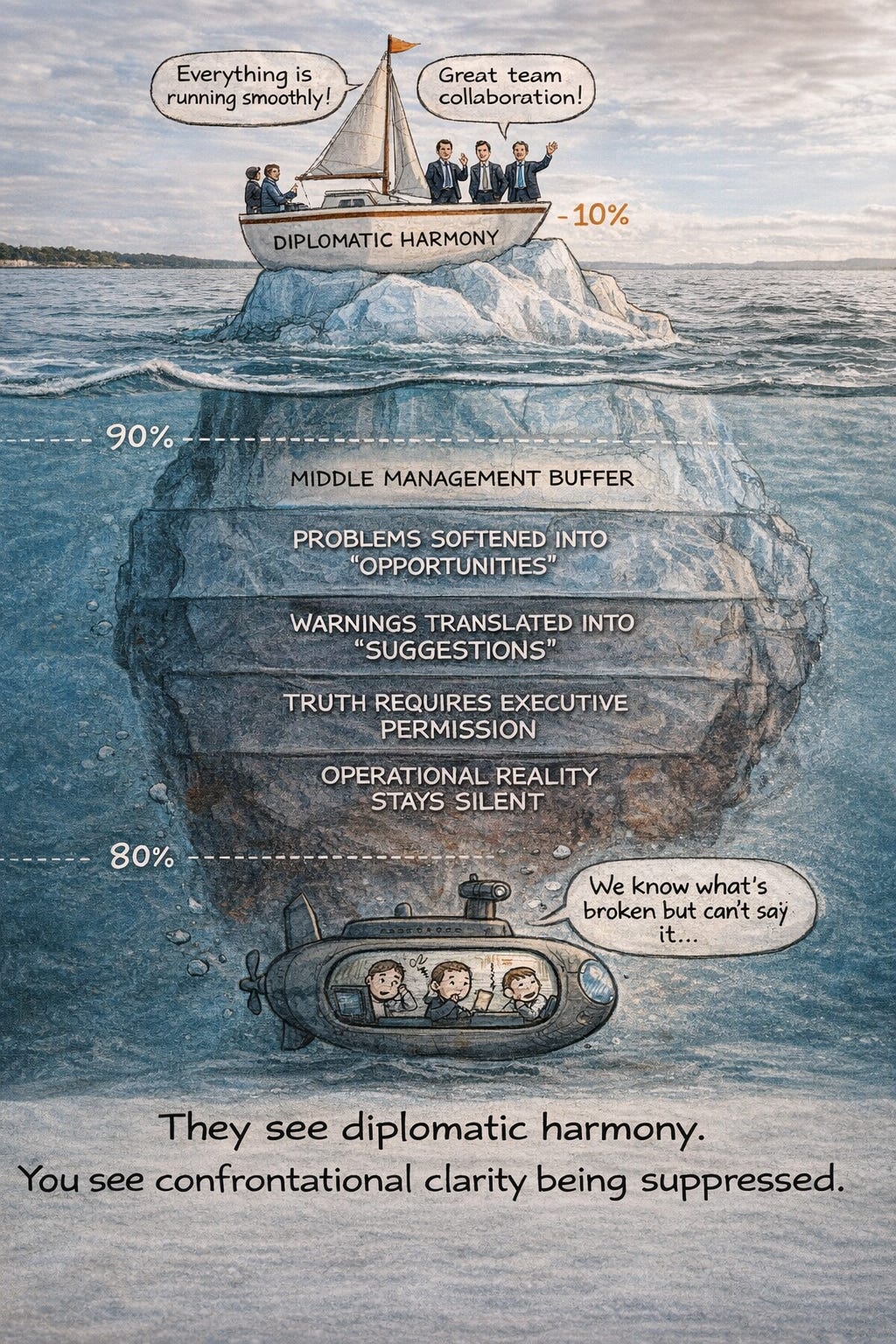
It’s the middle, the layers between operations and C-suite, that resist confrontational clarity most fiercely.
Why? Because confrontational clarity exposes that they’ve been translating problems into diplomatic language that prevents action. They’ve been the buffer that keeps uncomfortable truths from reaching decision-makers.
When I bypass that buffer with direct language, I’m not just stating a problem. I’m revealing that the buffer has been part of the problem.
That’s why it feels personal to them. Because it is.
Three weeks ago, I presented the cognitive load framework to a prospect’s operations team. Their response: “We’re very open to learn a completely different perspective on the OCC.”
Translation: Nobody has ever told them clearly that their systems are broken and why.
Three days ago, I posted on LinkedIn about cognitive load. 43,000 views, primarily from senior operations leaders at major carriers. Eleven saves. Dozens of private DMs saying “this is exactly right but I can’t say it publicly.”
Almost no public comments.
Why? Because publicly agreeing that your OCC wastes 70% of cognitive capacity is career-limiting when you’re below C-suite. Your boss might take it personally. Your peers might see it as disloyalty. The organization might label you “not a team player.”
So the truth stays private until operational failure makes it public.
This essay is about that dynamic. About what it means when people take confrontational clarity personally. About what it reveals when organizations prefer diplomatic evasion over operational truth. About what it costs when industries optimize for harmony while passengers sit stranded.
And yes, about what it’s cost me personally to keep speaking clearly in an industry that often punishes clarity.
But here’s the thing:
When three French airline CEO and Operations Manager of Groupe Dubreuil Aéro (Air Caraibes, FrenchBee, Air Caraibes Atlantique) went on camera to validate the cognitive load framework, they weren’t being German-direct. They were being operationally honest.
French culture values diplomatic communication more than German culture. And yet they stated clearly: “We stopped celebrating multitasking. Controllers spent 70% of capacity on system navigation. We redesigned around brain science.”
Why?
Because the cost of operational failure exceeded the cost of uncomfortable truth.
That’s the calculation every executive must eventually make. The question is whether they make it before or after their December 2025 moment.
I’m writing this because I’m tired of watching airlines make that calculation too late. I’m tired of seeing middle management take confrontational clarity personally while operational reality deteriorates. I’m tired of knowing that somewhere, right now, an operations manager is diplomatically softening a warning that should be stated clearly enough to trigger action.
And I’m tired of being told my communication style is “too direct” by people who’ve never sat in an OCC at 3 AM watching skilled controllers reduced to system button-pushers during cascading IROPS.
So yes, this essay will be direct. Confrontationally clear. Possibly uncomfortable.
If you take it personally, that’s information about you, not about the accuracy of what I’m saying.
If your organization can’t tolerate this level of clarity, that’s information about your organization’s readiness for the operational complexity you’re about to face.
And if aviation as an industry keeps resisting confrontational clarity in favor of diplomatic harmony, December 2025 will provide all the information passengers need about whose comfort we’ve been prioritizing.
The December 2025 Question
In December 2025, hundreds of thousands of passengers sat stranded. Billions in company value evaporated. Airlines that had spent years “optimizing” their operations discovered what their controllers had known quietly for years: the systems were broken.
The post-mortems will be diplomatic. “Unprecedented weather.” “Cascading effects.” “Lessons learned.”
But here’s the confrontational clarity: The systems were always broken. Leadership just preferred not to hear it said plainly.
This essay is about what that preference costs.
What Is Confrontational Clarity?
Confrontational clarity is stating observable reality in direct language that forces acknowledgment.
Not: “There may be opportunities to optimize controller workflows”
But: “70% of cognitive capacity is wasted on system navigation instead of operational decisions”
Not: “We should explore integrated solutions”
But: “You’re running 14 disconnected systems and wondering why controllers are exhausted”
Not: “Change management will be important”
But: “Your transformation will fail because your people are already at cognitive capacity”
The German language has a word for this kind of directness: Klartext. Plain text. No decoration. No softening. Just the truth, stated clearly enough that pretending not to understand becomes impossible.
I’m German. This is how I communicate. And after 30 years in aviation and 128 visits to Operations Control Centers worldwide, I’ve learned something important:
The people who need confrontational clarity most are the ones who resist it hardest.
What It Says About People Who Take It Personally
When someone takes confrontational clarity personally, they’re revealing something about themselves.
The Ego Defense
“You’re being aggressive.”
“That’s not how we communicate here.”
“You need to be more diplomatic.”
Translation: “You’re making me confront something I’ve been avoiding, and I’d rather attack your tone than address your content.”
Taking confrontational clarity personally is an ego defense mechanism. It shifts focus from the problem being named to the person naming it.
Classic pattern:
Me: “Your OCC design wastes 70% of controller cognitive capacity on system friction.”
Defensive response: “That’s quite harsh. We’ve put a lot of effort into our systems.”
Notice what just happened? We’re now discussing their feelings about the systems, not whether the systems actually work.
The Competence Question
People who take confrontational clarity personally often do so because it implies a competence gap.
If I say “your systems waste 70% of cognitive capacity,” and you’ve been responsible for those systems, hearing that clearly means confronting: “Have I been wrong for years?”
That’s uncomfortable. So instead of confronting the data, they confront the messenger.
But here’s the truth that confrontational clarity forces into the open: Being wrong about systems design doesn’t make you incompetent. Refusing to acknowledge it when shown the data does.
The Cultural Excuse
“That’s very German of you.”
“In our culture, we communicate more diplomatically.”
“That kind of directness doesn’t work here.”
This is the most insidious defense because it wraps ego protection in cultural sensitivity.
I’ve worked across 80+ countries. I understand Erin Meyer’s Culture Map. I know that French executives speak more diplomatically than Germans. That Southeast Asian cultures value harmony. That British understatement is its own art form.
But aviation doesn’t care about cultural communication preferences.
Physics is confrontationally clear: If you don’t have enough cognitive runway to land your transformation, you crash. The laws of human attention don’t adjust for diplomatic phrasing.
When someone hides behind “cultural differences” to avoid confrontational clarity, ask yourself: Are they protecting cultural sensitivity, or protecting themselves from uncomfortable truths?
What It Says About Organizations That Don’t Want To Hear Things Clearly
Organizations that resist confrontational clarity are revealing their governance structure.
The Consensus Trap
Some organizations require consensus before action. This sounds democratic. It’s actually paralysis dressed as inclusion.
How this manifests:
Clear problem statement: “Controllers spend 70% of capacity on navigation friction”
Consensus response: “Let’s form a working group to study this”
Six months later: “We need more data before making recommendations”
Twelve months later: “The transformation landscape has shifted, let’s revisit our approach”
Meanwhile, controllers burn out. IROPS cascade. Passengers get stranded.
Confrontational clarity bypasses this. It forces the organization to either act or explicitly choose inaction. There’s no middle ground of “studying the issue.”
Organizations that can’t tolerate this are organizations that have optimized for process over outcomes.
The Hierarchy Problem
In hierarchical organizations, confrontational clarity from below is seen as insubordination. From peers, it’s seen as aggression. From above, it’s acceptable.
This creates a truth bottleneck: Only people with sufficient positional authority can state reality clearly.
The result:
Junior controllers who see the problems daily can’t speak
Middle managers who know the truth diplomatically soften it
Senior executives hear sanitized versions that don’t trigger action
Problems compound until they explode
The December 2025 failures? They started years earlier with operations managers who saw the problems but couldn’t say them clearly enough to penetrate the hierarchy.
Organizations that punish confrontational clarity from below are organizations optimizing for comfortable ignorance over uncomfortable truth.
The Consultant Dance
Many organizations hire consultants specifically to avoid confrontational clarity from internal sources.
The consultant gives them the same truth that operations managers have been saying for years. But because it comes with PowerPoint polish and a six-figure invoice, leadership listens.
The subtext: “We’ll accept confrontational clarity if it’s expensive enough and comes from outside.”
This reveals organizational dysfunction. If you only believe hard truths when outsiders say them, your internal communication is broken.
What It Says About Industries That Prefer Harmony Over Truth
Aviation is a safety-critical industry. Lives depend on operational decisions. Billions of dollars move on controller choices made under pressure.
And yet.
When I post that controllers waste 70% of cognitive capacity on system friction, I get:
43,000 views
11 saves (people bookmarking privately)
Dozens of DMs saying “this is exactly right but I can’t say it publicly”
Almost no public comments
Why?
Because aviation has evolved a culture where harmony is valued over truth. Where “being a team player” means not pointing out that the emperor has no clothes. Where career advancement requires diplomatic silence about systemic dysfunction.
The Cost of Industry Harmony
Let’s talk about December 2025.
Southwest’s operational meltdown wasn’t caused by weather. It was caused by systems that couldn’t handle operational complexity. Controllers knew this. They’d been working around it for years.
But publicly saying “our crew tracking system is fundamentally broken” is career-limiting. So the truth stayed private until it became public in the form of 16,700+ cancelled flights.
Harmony preserved. $1.1 billion in losses incurred.
This pattern repeats across the industry:
Airlines celebrate “controller resilience” (code for: tolerating broken systems)
Vendors market “digital transformation” (code for: adding more complexity)
Consultants recommend “change management” (code for: teaching people to accept dysfunction)
Everyone maintains harmony. Everyone avoids confrontational clarity.
And passengers pay the price when the facade cracks.
The Group A vs Group B Split
By 2027, airlines will split into two categories.
Group A: Still preferring harmony over truth
Celebrates controller “multitasking” (really: cognitive overload)
Resists confrontational clarity about system waste
Maintains diplomatic communication about operational strain
Experiences recurring IROPS failures they can’t quite explain
Group B: Accepts confrontational clarity as operational necessity
Measures cognitive load as rigorously as fuel burn
Tolerates direct statements about system dysfunction
Makes transformation decisions based on capacity reality, not vendor promises
Recovers faster from disruptions because they’ve fixed root causes
The difference between these groups isn’t technology. It’s tolerance for confrontational clarity.
Group A will keep hiring consultants to diplomatically tell them what their operations managers already know.
Group B will fix the problems.
The Regulatory Gap
Here’s the most damning indictment of aviation’s preference for harmony over truth:
We regulate cockpit design with extreme rigor. 14 CFR Part 25 mandates Human Factors testing for every switch, display, and alert. Because lives depend on pilot cognitive capacity.
Operations Control Centers have no equivalent regulation.
Airlines can design OCCs that violate every Human Factors principle, overload controllers with 200+ alerts per shift across 14 disconnected systems, and call it “operational efficiency.”
Why no regulation? Because regulating OCCs would require confrontational clarity about how badly they’re currently designed.
The industry prefers harmony. So controllers burn out quietly, and IROPS cascade predictably, and passengers get stranded repeatedly.
And we all maintain the polite fiction that this is somehow acceptable.
The French CEO Problem (And Why It Matters)
I mentioned that French airline CEO’s went on camera about their OCC transformation. CEO, CEO, Project Manager. Groupe Dubreuil Aéro.
French executives are more diplomatic than Germans. They soften edges. They build consensus. They value harmony.
And yet they went on camera and said:
“We stopped celebrating multitasking”
“Controllers spent 70% of capacity on system navigation”
“We redesigned around brain science instead of wishful thinking”
Why did they accept confrontational clarity when their cultural default is diplomatic communication?
Because the cost of harmony exceeded the cost of truth.
They looked at their operational data and realized: continuing to diplomatically avoid the cognitive load problem would cost more than confrontationally acknowledging it.
This is the calculation every executive must eventually make.
The question is whether they make it before or after their December 2025 moment.
When Confrontational Clarity Is Actually Required
Some industries can afford diplomatic communication. Fashion. Marketing. Consumer goods.
If you’re wrong about a product launch, you lose money. Uncomfortable, but not catastrophic.
Aviation can’t afford this luxury.
When an Operations Control Center fails, people don’t just lose money. They lose:
Time (stranded passengers)
Trust (brand damage)
Safety margins (fatigued controllers making critical decisions)
Competitive position (operational reliability is increasingly a differentiator)
Lives (in worst cases, operational failures cascade to safety events)
In safety-critical industries, diplomatic evasion of problems is organizational negligence.
The Surgical Theater Standard
Surgeons use confrontational clarity. In the OR, if a nurse sees the surgeon about to make a mistake, they don’t say:
“Doctor, perhaps we might want to consider whether the current approach optimally aligns with the patient’s anatomical configuration.”
They say: “Stop. Wrong side.”
That’s confrontational clarity. Direct. Unambiguous. Impossible to misunderstand.
Aviation OCCs need the same standard. Controllers should be able to say:
“This system is broken and wasting our cognitive capacity”
Not: “We’re experiencing some workflow optimization opportunities that might benefit from additional tooling considerations.”
If you can’t tolerate confrontational clarity in your operational environment, you’re not running a high-reliability organization. You’re running a political theater that happens to also operate aircraft.
The Cognitive Load of Diplomatic Communication
Here’s the paradox nobody talks about:
Diplomatic communication itself consumes cognitive capacity.
When you force people to translate clear thoughts into diplomatically acceptable language, you’re adding cognitive load. Every euphemism requires mental processing. Every softened statement requires interpretation.
In an OCC where controllers are already spending 70% of capacity on system friction, making them also navigate diplomatic communication about the problems is compounding the dysfunction you’re trying diplomatically to avoid naming.
Confrontational clarity is cognitively efficient.
“This system wastes 70% of your capacity” requires zero interpretation. It’s clear. You can immediately decide to agree, disagree, or investigate.
“We’re exploring opportunities to optimize workflow efficiency through enhanced tool integration” requires parsing. What does that mean? Are we saying there’s a problem? If so, how big? What action is implied?
Organizations that resist confrontational clarity are forcing their people to waste cognitive capacity on diplomatic translation instead of operational decisions.
It’s the meta-problem: You’re creating cognitive load by refusing to clearly name the cognitive load problem.
How To Know If You’re The Problem
Some diagnostic questions:
When someone clearly states a problem in your organization, is your first response:
A) Investigate if the statement is accurate
B) Tone-police how the statement was delivered
If B, you’re optimizing for comfort over truth.
When operational staff privately tell you about systemic issues, do you:
A) Thank them for the clarity and investigate
B) Tell them to “go through proper channels” or “be more diplomatic”
If B, you’ve created a hierarchy where truth can’t flow up.
When consultants tell you the same things your staff have been saying for years, do you:
A) Wonder why you didn’t listen to your staff
B) Feel validated that an “expert” confirmed your staff were exaggerating
If B, you don’t trust your organization’s own expertise.
When confrontational clarity makes you uncomfortable, do you:
A) Examine why the truth is uncomfortable
B) Attack the person delivering it
If B, you’ve chosen ego protection over organizational learning.
After a major operational failure, does your organization:
A) Seek confrontational clarity about root causes
B) Produce diplomatic post-mortems that assign no clear responsibility
If B, you’re optimizing to repeat the failure.
The December 2025 Test
Let me offer a prediction.
In December 2025, an airline faced massive operational disruptions. Hundreds of thousands of passengers affected. Billions in company value impacted.
The post-mortem will reveal: Controllers were at cognitive capacity. Systems were fragmented. Transformation initiatives had added complexity instead of reducing it. Leadership had been warned.
The real question: How many warnings did leadership receive? And how many were delivered with confrontational clarity vs. diplomatic softening?
My hypothesis: The airlines that fail hardest will be the ones that most successfully suppressed confrontational clarity.
Because when everyone is being diplomatic about systemic problems, leadership can plausibly claim they “didn’t know how bad it was.”
Confrontational clarity removes that excuse.
When someone tells you clearly “we’re at 70% cognitive capacity waste and cannot absorb another system,” and you proceed anyway, you’re making an informed choice to fail.
Diplomatic communication creates plausible deniability. Confrontational clarity creates accountability.
Industries that resist confrontational clarity are industries that prefer to fail without accountability.
What I’m Actually Saying
This isn’t a manifesto for rudeness. It’s not permission to be an asshole in the name of “directness.”
Confrontational clarity is:
Specific: “70% of cognitive capacity wasted on navigation” not “things could be better”
Evidence-based: Eye-tracking research, neuroscience, operational data
Actionable: Clear enough to make decisions on
Professional: Focused on systems and outcomes, not personalities
Confrontational clarity is not:
Personal attacks
Emotion-driven venting
Blame assignment without solutions
Ignoring cultural context maliciously
The difference: Confrontational clarity serves the mission. Being an asshole serves the ego.
In aviation, the mission is operational safety and reliability. When diplomatic communication protects that mission better than confrontational clarity, use diplomatic communication.
But when diplomatic communication obscures problems that threaten the mission, confrontational clarity becomes a moral obligation.
The Zeitgeist Has Changed (Whether You’ve Noticed Or Not)
There’s a larger shift happening that makes this conversation urgent.
For roughly two decades, organizational culture optimized for feelings management. “Psychological safety” became code for “never make anyone uncomfortable.” “Inclusive communication” became code for “say nothing clearly enough to act on.”
This wasn’t malicious. It was a pendulum swing.
After generations of command-and-control leadership that ignored human needs, organizations overcorrected. They created environments where protecting feelings became more important than protecting outcomes.
That era is ending.
Why The Overcorrection Is Collapsing
Not because people became less empathetic. But because the scale of consequences changed.
When your company makes widgets and someone’s feelings get hurt in a product review meeting, the cost is interpersonal. Uncomfortable, but contained.
When your airline operations affect hundreds of thousands of passengers, when your decisions cascade through global networks, when your cognitive load management determines whether people get home for Christmas or sit stranded in airports—individual feelings are no longer the primary moral consideration.
The moral calculation shifted:
Old equation: Protect individual comfort > organizational truth
New equation: Protect millions of affected people > protect dozens of decision-makers from discomfort
The AI Acceleration
AI is making this shift inevitable.
When I tell a COO “your transformation will fail because your people are already at cognitive capacity,” I’m competing with AI vendors promising to “augment human intelligence” and “enhance decision-making.”
The AI pitch is seductive: Just add this layer, it’ll help your controllers manage complexity.
The confrontational clarity: Your controllers are already drowning. Adding AI without fixing the underlying cognitive load problem is like giving a drowning person a snorkel. You’re not solving the problem, you’re adding complexity to it.
By 2026-2027, airlines will deploy AI systems. Some will reduce cognitive load. Many will increase it.
The difference? Whether leadership tolerated confrontational clarity about baseline cognitive capacity before adding AI, or whether they prioritized vendor promises over operational reality because the vendor promises didn’t hurt anyone’s feelings.
Hundreds of thousands of passengers will experience the difference.
Their stranded status won’t care about whether the transformation was communicated diplomatically.
The Generational Divide
There’s a generational pattern worth naming.
Boomer/Gen X leadership: Often more comfortable with confrontational clarity (they came up in more direct communication cultures)
Millennial middle management: Often trained in feelings-first communication frameworks
Gen Z operations staff: Increasingly intolerant of diplomatic evasion (they want problems named clearly so they can fix them)
The result: A sandwich where middle management diplomatically softens messages flowing both up and down, creating a translation layer that wastes everyone’s time and cognitive capacity.
The zeitgeist shift is partly generational. Younger operations professionals are asking: “Why are we spending 30 minutes in a meeting diplomatically discussing a problem we could solve in 5 minutes if someone just said clearly what’s broken?”
They’re right to ask.
The Scale Question
Here’s the confrontational clarity that makes feelings-first advocates uncomfortable:
Your feelings about how I communicate this message affect you and maybe your immediate team.
The operational failures caused by refusing to hear this message clearly affect hundreds of thousands of passengers and billions in company value.
These are not equivalent moral weights.
I’m not saying your feelings don’t matter. I’m saying they don’t matter more than operational reality when the stakes are this high.
A thought experiment:
You’re a passenger. Your flight is cancelled. You’re stranded. You miss your sister’s wedding. This happened because airline leadership couldn’t tolerate confrontational clarity about cognitive load problems, so they deployed a transformation initiative that overloaded controllers who then couldn’t manage the IROPS cascade.
Do you care that the leadership team maintained diplomatic communication norms?
Or do you wish someone had been confrontationally clear about the problem before it affected you?
Scale changes the moral calculus.
When your decisions affect millions of people, protecting decision-makers from uncomfortable truths is not kindness, it’s abdication of responsibility.
The New Social Contract
The post-2020 world created a new implicit social contract:
Old contract: Organizations protect employee feelings, employees accept diplomatic evasion of problems
New contract: Organizations expect high performance in high-stakes environments, employees expect confrontational clarity about what’s actually expected and what’s actually broken
Remote work, supply chain disruptions, pandemic operations, AI acceleration, all of these created environments where diplomatic ambiguity became operationally dangerous.
You can’t run a distributed operations center on diplomatically vague instructions. You can’t manage IROPS remotely if controllers have to interpret whether leadership is “suggesting consideration of” or “requiring immediate implementation of” a decision.
Confrontational clarity became operational necessity.
The organizations that recognized this survived disruption better. The ones still optimizing for feelings-first communication got hammered.
What “Psychological Safety” Actually Means
There’s a bastardization of Amy Edmondson’s psychological safety research happening in organizations.
Edmondson’s research: Psychological safety means people can speak truth to power without fear of punishment
Corporate bastardization: Psychological safety means never making anyone uncomfortable with direct feedback
These are opposites.
Real psychological safety requires confrontational clarity. It means an operations manager can walk into the CEO’s office and say “our OCC design is broken and we’re going to fail” without getting fired for insubordination.
Fake psychological safety is “everyone be nice to each other” which actually means “don’t rock the boat with uncomfortable truths.”
Aviation needs real psychological safety: the kind that protects confrontational clarity.
The zeitgeist is shifting back toward this original definition. Because the consequences of fake psychological safety are now visible in operational failures.
The Accountability Reckoning
Something else is changing: accountability for leadership decisions.
When December 2025 disruptions hit, there will be shareholder lawsuits. Board investigations. Regulatory scrutiny.
The question will be asked: “Did leadership know about the cognitive load problems before the transformation?”
If the answer is “yes, but it was communicated diplomatically so they could ignore it,” that’s no longer an acceptable defense.
The zeitgeist shift: From “leaders can plausibly claim ignorance if problems weren’t stated clearly enough” to “leaders are accountable for creating environments where problems can be stated clearly.”
Confrontational clarity creates accountability. That’s why some leaders resist it.
But the era where leaders could hide behind “nobody told me clearly enough” is ending. Because:
Operations staff are documenting the diplomatic evasions
Regulators are asking harder questions
Shareholders are less tolerant of preventable failures
The scale of disruption makes the patterns undeniable
The new standard: If you’re in leadership and you can’t tolerate confrontational clarity about operational problems, you’re not qualified for the role when hundreds of thousands of people depend on your decisions.
Why This Makes People Angry
This chapter will make some readers angry.
“You’re saying my feelings don’t matter!”
No. I’m saying your feelings matter less than the operational outcomes affecting millions of people when you’re in a position of systemic responsibility.
That’s not cruelty. That’s proportionality.
A surgeon’s feelings about criticism of their technique matter less than patient outcomes.
A pilot’s feelings about confrontational clarity from ATC matter less than collision avoidance.
An airline executive’s feelings about direct feedback on cognitive load problems matter less than passenger safety and operational reliability.
This isn’t controversial in other safety-critical domains. Why is it controversial in aviation operations?
Because we’ve spent two decades teaching leaders that their emotional comfort is the primary consideration in organizational communication.
The zeitgeist is correcting that imbalance.
Not because we’ve become less human. But because the scale of our systems demands it.
The Choice
Every organization faces a choice about how truth flows.
Option A: Diplomatic harmony
Comfortable communication
Preserved egos
Protected hierarchies
Delayed action
Compounding problems
Eventual crisis
Option B: Confrontational clarity
Uncomfortable truth
Challenged assumptions
Flatter information flow
Faster action
Addressed problems
Sustainable operations
Most organizations choose A until crisis forces them to B.
The smart ones choose B before the crisis.
Why I Write This Way
People ask why I’m so direct. Why I don’t soften my language. Why I post things like “cognitive bankruptcy” and “Group A vs Group B” and “designing for the brain you wish controllers had.”
Because aviation doesn’t have time for diplomatic evasion.
I’ve been in OCCs at 3 AM during cascading failures. I’ve watched brilliant controllers reduced to system button-pushers. I’ve seen airlines waste billions on transformations that made problems worse.
And I’ve watched industries protect harmony over truth until passengers pay the price.
I’m German. I speak Klartext. And aviation operations is exactly the environment where confrontational clarity isn’t optional, it’s survival.
The question isn’t whether I should communicate more diplomatically.
The question is whether you can afford to keep avoiding truth diplomatically while your operations burn cognitive capacity your controllers don’t have to waste.
The Invitation
If you’ve read this far, you’re probably in one of three categories:
1. You recognize the truth and feel validated
Good. Now stop saving these posts privately and start having confrontational clarity conversations in your organization. Someone with your positional authority can say things that operations managers can’t.
2. You recognize the truth but think I’m being too harsh
Ask yourself: Am I objecting to the accuracy, or the discomfort? If the statements are true, why does the directness bother you? What are you protecting by requiring diplomatic softening?
3. You think I’m wrong about the cognitive load crisis
Great. Let’s have that debate with confrontational clarity. Show me your OCC data. Show me your controller cognitive utilization rates. Show me your transformation success rates.
I’ll show you mine: 128 OCC visits, eye-tracking research, neuroscience backing, customer testimonials with CEO video evidence.
Let’s be confrontationally clear about who has the data.
The Final Question
It’s not 2027 yet. You have time.
The question every airline executive should ask:
When the December 2026 disruption comes, and it will come for some airlines, will you be in Group A or Group B?
Group A: Diplomatically surprised by a failure you’d been diplomatically warned about
Group B: Confrontationally clear about your operational reality and prepared accordingly
The choice is yours.
But choose with confrontational clarity about what that choice means.
Because aviation doesn’t grade on diplomacy.
It grades on operational outcomes.
And passengers don’t care if your failure was delivered with proper cultural sensitivity.
Daniel Stecher is VP Business Development at IBS Software and founder of the Airline Crewing & Operations Enigma community. After 30 years in aviation operations and 128 OCC visits across 80+ countries, he has concluded that the industry’s biggest constraint isn’t technology, it’s tolerance for confrontational clarity about how badly current systems work. He’s German, so he mentions this directly instead of diplomatically implying it.
The Groupe Dubreuil Aéro CEO testimonials referenced in this article will be published February 17, 2026.
Footnote: Why This Is Called “Confrontational Clarity” And Not Just “Honesty”
Because “honesty” lets you off the hook.
You can be “honest” in ways that are vague enough to avoid action:
“We have some challenges” (honest, not clear)
“There’s room for improvement” (honest, not confrontational)
“We’re working on it” (honest, not specific)
Confrontational clarity is honesty that forces acknowledgment and action.
It’s honest + specific + direct enough that ignoring it requires willful blindness.
That’s the standard aviation operations needs.
That’s the standard most airlines resist.
That’s why December 2026 will happen.
Leave the personal ego behind when going to work.